Uncategorized

Obituary

by Spee

ellen-harris-braun-obit

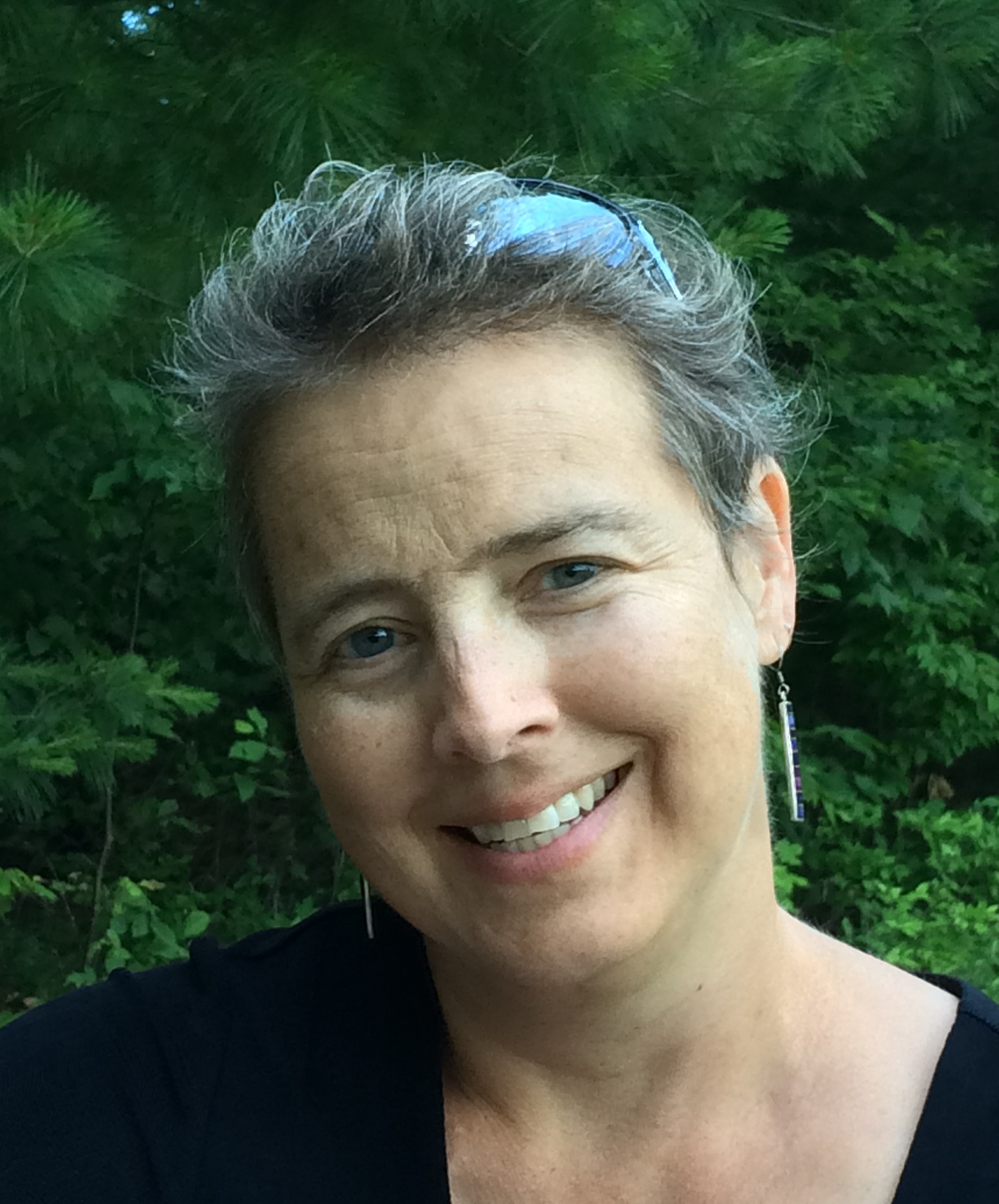
Ellen Key Harris-Braun, 50, of East Chatham, New York, died at home Friday, October 28, 2016. Born in Atlanta, Georgia, she attended high school in Rochester, New York, and graduated summa cum laude from Yale University with a BA in anthropology. A life-long science fiction reader, she turned her honors thesis on the use of anthropological concepts in science fiction into an application to Del Rey Books, the sci-fi division of Random House. There, in the early 90s (before the Web) she began an email newsletter, including writing advice, that ultimately became the independent Online Writing Workshop, which she and her husband, Eric Eugene Harris-Braun, directed. During her last few years at Random House, she was part of a pioneer group in charge of that publisher’s online projects.

Ellen was a midwife. She trained as a childbirth instructor after the birth of William, her first child, then became a doula after the birth of Jesse, her second. As she began her midwifery studies, she served first as a public member of the Commission for the Accreditation of Birth Centers and then as director of data development for the Midwives Alliance of North America’s division of research. As a Certified Professional Midwife, she attended home births in Massachusetts and New York, working with River and Mountain Midwives and Local Care Midwifery.

She and Eric designed the data collection software for MANA’s statistics website, an ongoing project that recently led to the publication of a landmark study of almost 17,000 planned home births. In 2014 she received the MANA Star Award for her contributions to the profession, and that organization has named its two research awards (one for students, one for practicing midwives) in her honor. In 2015 the Midwifery Institute of Philadelphia, where she had been pursuing graduate studies, established the Ellen Harris-Braun Midwife Scholar Award and presented the first one to Ellen.

Her love of words and her sharp wit – often described as not TSA-approved – were relished by her friends and family and have been passed on to her children. Evidence can be found on her blog, World of the Sick/World of the Well, an account of her illness that is at once informative and, almost to the end, a delight to read (ellen.harris-braun.com).

In addition to her husband and children, Ellen is survived by her mother Kathryn Key Montgomery of New Orleans; her siblings, Anne Montgomery Hunter of San Francisco, Debra S. Hunter of San Rafael, California, Lisa M. Hunter of Madison, Wisconsin, James Paul Hunter of Atlanta, and their father James Paul Hunter of Charlottesville, Virginia; her step-mother, Laurie Randolph Barili Harris of Atlanta; her brother- and sister-in-law Jens and Spee Braun; ten Harris cousins; and beloved members of the Quaker Intentional Village-Canaan. Her father, David Jesse Harris of Atlanta, preceded her in death.

A memorial service will be held at 11 am Saturday, November 12, at the Old Chatham Quaker Meeting House. Her family and friends are grateful to the helping circles that have sustained them and to Rufus Collea, MD, Elizabeth Hanlon, RN, and Jeffrey Arp-Sandel, MD. Memorial gifts may be made to the Ellen Key Harris-Braun Research Fund at the Foundation for the Advancement of Midwifery (www.foundationformidwifery.org).
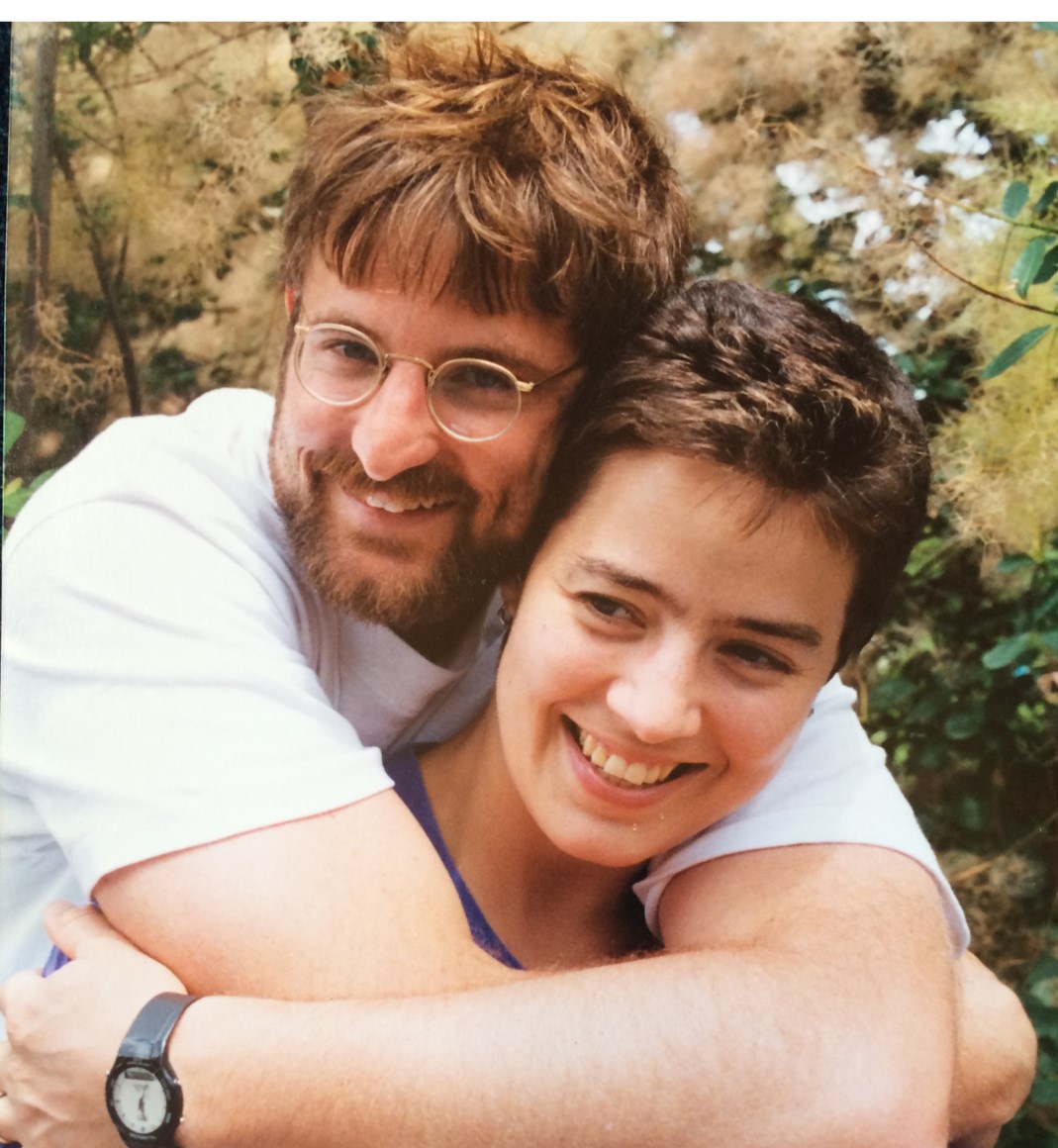
Memorial Service to celebrate Ellen's life

by Spee

A memorial service in celebration of Ellen’s life will be held at the Quaker meetinghouse in Old Chatham, NY, on Saturday, November 12, at 11:00 a.m. with a reception to follow. Directions may be found on the website of Old Chatham Quaker Meeting here. If you plan to attend from out of town and need overnight accommodations, please email memorial@harris-braun.com.

We hold deep gratitude for all your love, prayers, chocolate, healthy food, and other support that made it possible for Ellen to spend her final months at home surrounded by loved ones.

We welcome your Ellen stories and memories here on this blog or by snail mail to Eric at 229 Bradley’s Crossing Road, Stop 19, East Chatham, NY 12060.

Time to fly

by Spee

Ellen took her last breath around 5:40 p.m. this evening. Her death coincided with the start of two gatherings of communities deeply important to her. Here in the Quaker Intentional Village-Canaan, we were coming together in the Farmhouse for the start of our semi-annual retreat. A few miles away at the Quaker conference center Powell House, midwives were gathering for the annual weekend retreat of the New York State Association of Licensed Midwives. This weekend will see many tears mixed with storytelling and sharing of memories. We welcome your Ellen stories and memories here on this blog or by snail mail to Eric at 229 Bradley’s Crossing Road, Stop 19, East Chatham, NY 12060.

eric-ellen

Guest post: Dropping in

by Spee

Contributed by Ellen’s sister Lisa

Aaron and I arrived today from Wisconsin, to see Ellen and everyone else here and because we’d been scheduled to come this weekend for months and were told we’d be needed. We have so appreciated Spee’s blog postings and everything everyone in this loving circle has been doing to support Ellen and her world and to keep her comfortable. So at Spee’s invitation (and as she continues to recover use of her left hand after last week’s fall) here is our experience today of seeing Ellen and being in the midst of the community of care that surrounds her.

Kathryn insisted on picking us up from the airport. We dropped suitcases at Jens and Spee’s and they offered hugs and hospitality. When we went on to Ellen and Eric’s house, Anne U had been sitting with Ellen, and as Aaron and Kathryn and I arrived from the airport and grocery, Eric was just taking over with Ellen. Anne gave us an update on Ellen’s afternoon, which included some wakefulness and time sitting in her chair, then Anne left. Will and Jesse were off with cousin Natalie shopping for used clothing; later they came home with their finds. We helped Kathryn put away groceries and make a dinner plan, and after a while Eric came down to greet us with warm hugs and a somber manner, and let us take some time to sit with Ellen ourselves.

She was asleep; we are told she is now sleeping for most of the day and night. She looks very different from the time of our last visit: sicker, thinner, and somehow paler. She was settled in her own bed, and though the equipment of illness (wheelchair, etc) is in the room, there was no aroma of illness or sense of medical interruption as she slept. I was immediately struck by the fact that Ellen is at home, in her own bed, with her own purple comforter tucked around her, with the gorgeous colors of autumn outside her own window. There was a slight furrow to her brow that her core care team has tried hard to interpret, and Eric, Kathryn, Anne U, Shivani, and hospice nurse Elizabeth have established a routine for her pain medication and other functions that seems to be giving her relief and ease for this new, quieter phase. This afternoon Ellen was breathing comfortably and the room was silent except for the patter and occasional fury of steady rain on the roof above her bed.

We decided not to risk waking her by hugging her or speaking but sat peacefully by her bedside for a while before Eric joined us; then we headed back downstairs where the kitchen had been cleaned by Claire the day before, where Josie had left a list of her cleaning projects that week, where the refrigerator was full of good fresh food from a lot of loving QIVCers, neighbors, and other friends, and from Gina who brings homemade food every Friday. Will went to pick up Eric’s friend Jean-François from the train station, and when he got home we sat down to dinner - Eric upstairs with Ellen and JF - while Jesse and Will joined us with Kathryn. When Shivani arrived to be with Ellen, Eric and JF came down to eat.

The house glowed with the dull light of a rainy fall day. Pink and yellow snapdragons brightened the kitchen counter. Tomatoes of all sizes and shapes - small green cherries, big twisty orange ones, large round variegated red and yellow orbs - were spread across the living room windowsill in advance of the first frost. Everything felt very quiet even when there was talk. Part of this seems to us to be the stillness intrinsic to the location of QIVC. Part of this seems to be about the sadness that Ellen’s voice is almost entirely absent and that the hard work of caring for her as she dies now goes on largely without her active, verbal, conscious participation. Part of this is the set of decisions made earlier this week as recommended by Elizabeth, the hospice nurse, and summarized below by Spee:

The overall idea is that we caregivers will back off and give Ellen the space to “do the hard work of dying.”  She has one foot in this world and one in the next and we need to help her go. We will no longer proactively engage with Ellen and seek in-this-world connection with her (ah, the grief in giving up those exchanges of words and gestures we were having). We will not ask her questions about her state, although we’ll certainly still be assessing her comfort level and seeking to keep that high. We won’t ask her whether she wants us to do X; we’ll say, “I’m just going to give you X now, which will help you be more comfortable” and proceed. We will, however, console and reassure her and continue to let her know we love her.
So part of the quiet in the house is about the integrity of purpose that the grieving, determined people who love Ellen bring to her care. Part of it is about how different this experience is for everyone involved.

We are grateful to be in this caring community today, and grateful for Ellen’s life, the life she has shared at different points with us and others, the life she has made here with her family and community.

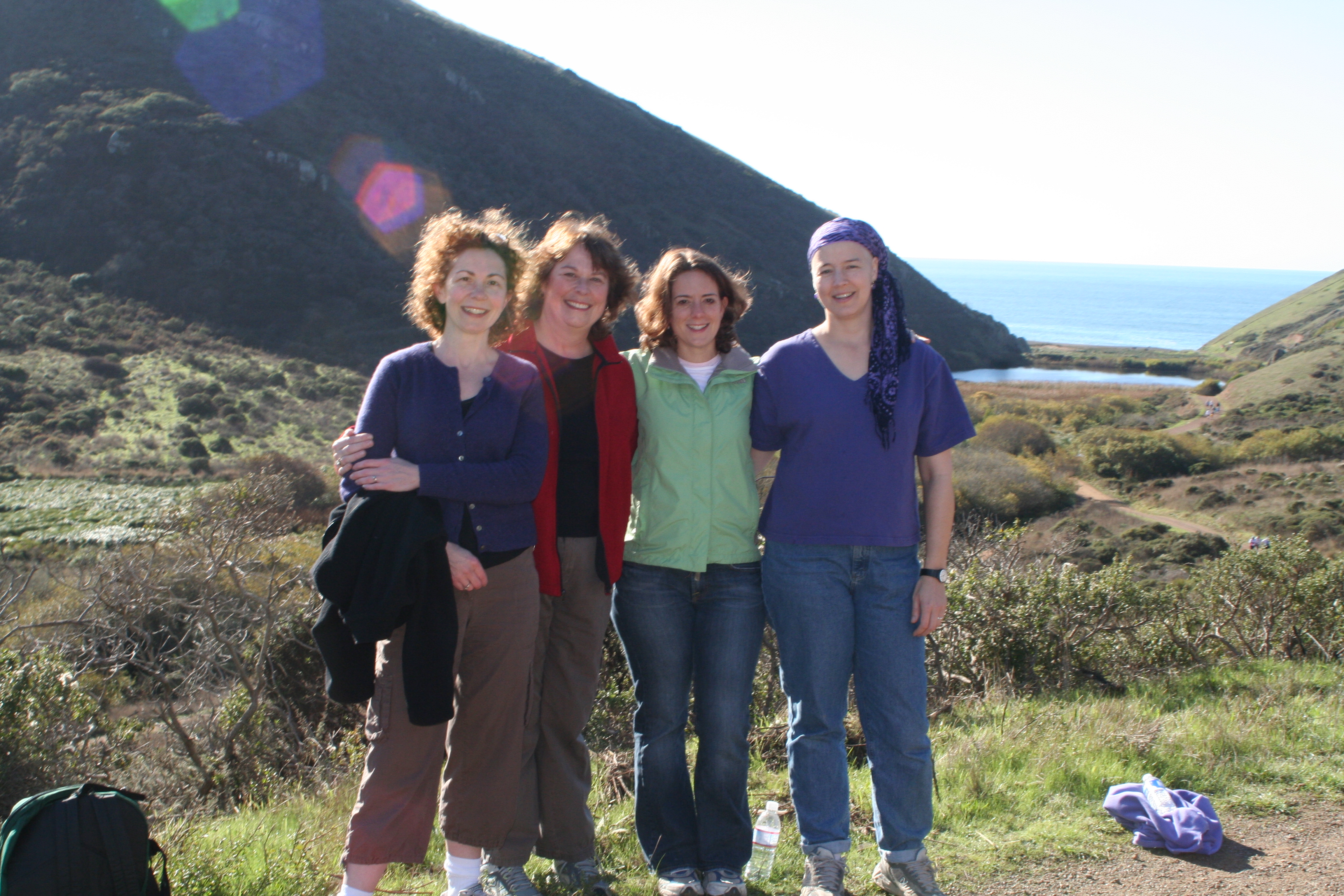
Below is a photo of the four sisters: Lisa, Deb, Anne, and Ellen

img_8183-copy

Caregiver Tools

by Eric

caregiver-tools1One gorgeous October day after the next comes and goes, and the moon now wanes after filling the eastern sky with magnificent moon rises these past evenings. Ellen has endured increased pain and discomfort, and her caregivers adjust this and that to find the best way to ease her journey. We wonder how much longer she can persevere and whether we have done an adequate job in helping her complete what she needed to get done and in giving her permission to let go and die.
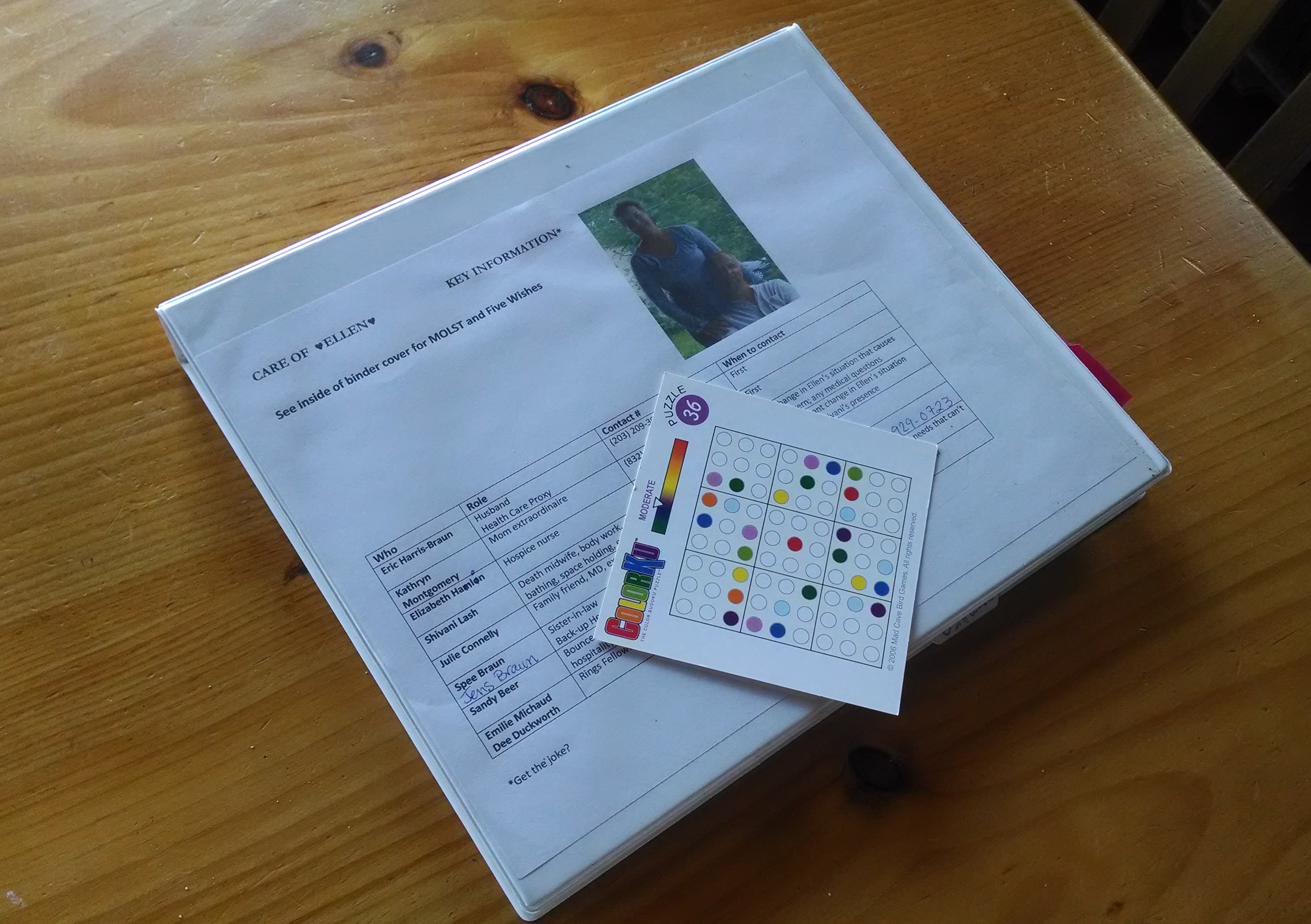
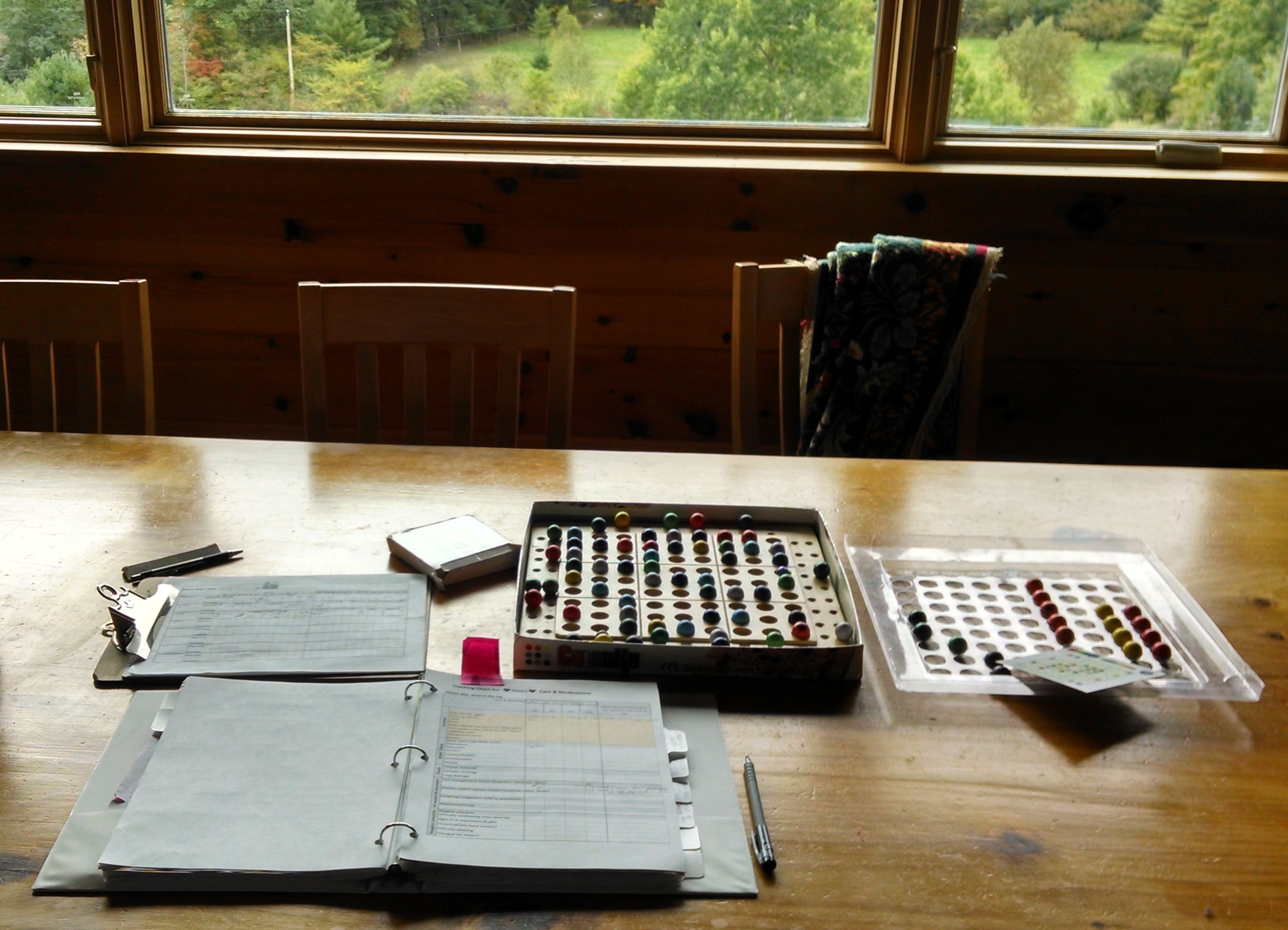
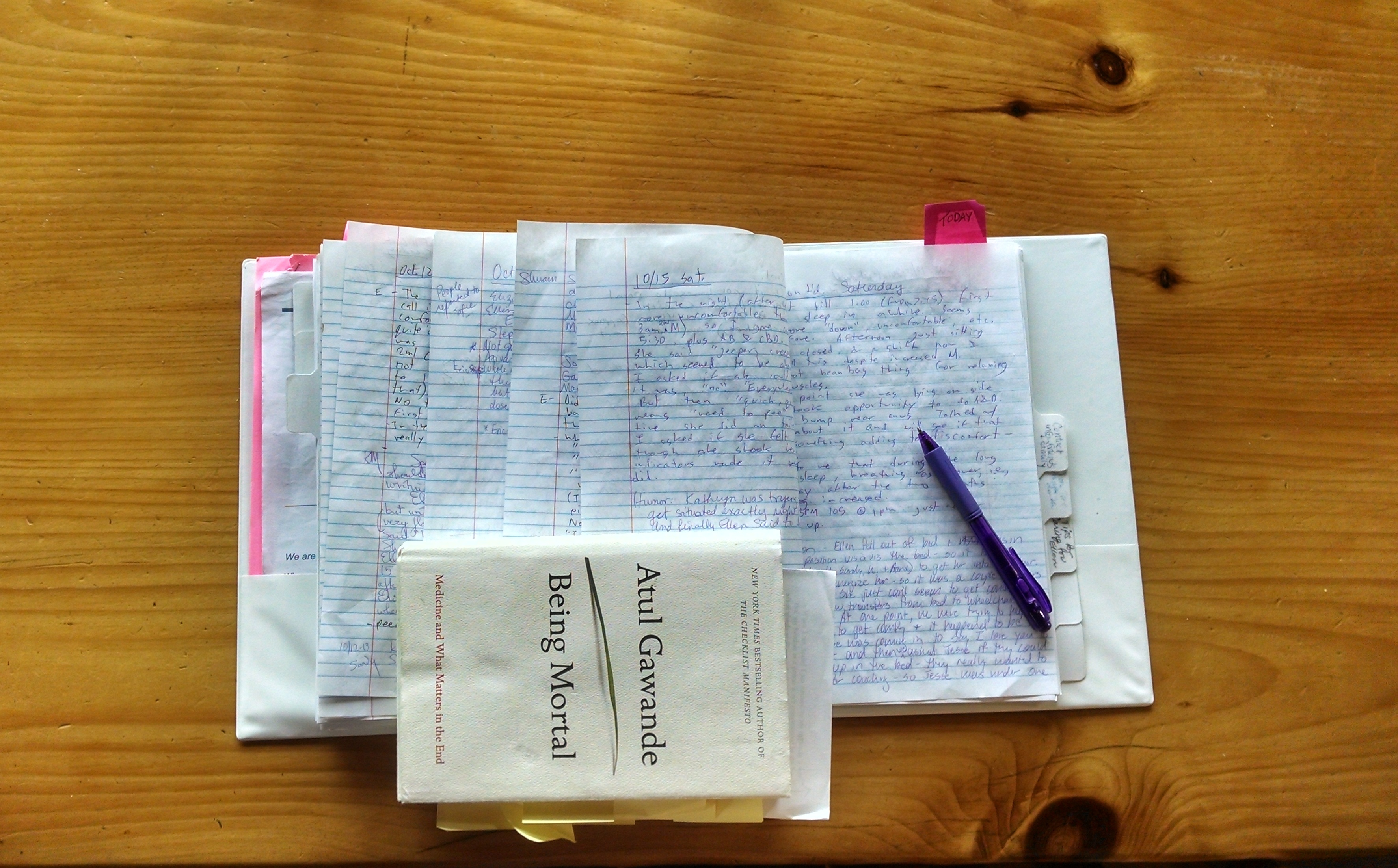
We caregivers have collected a range of tools, some of them from those who cared for our dear friend Azim in his final months earlier this year. These live primarily on the Harris-Braun dining room table and include a white binder, a purple pen, a clipboard that often is upstairs close to Ellen, the game ColorKu, and the sunflower blanket. Here’s how they serve us, in reverse order:

Sunflower Blanket - We wrap ourselves in its warm embrace when we want peaceful, relaxing time on the porch and it’s chilly outside.

ColorKu - This game provides all the benefits of Sudoku - calms and focuses the mind and helps one decompress emotionally - but also is readily tackled with two or three players who see things differently and delightfully come up with solutions for the next move. Plus ColorKu’s brightly painted wooden balls please the eye and cheer the soul. With 104 puzzle cards on five levels of difficulty - the top ones being “tough” and “extreme” - we can go for it, if we’re up for a challenge, or stick with a more soothing “easy” one. Our game skills have grown and we’re regularly tackling the tougher puzzles with success. (We’ve learned the hard way that it helps if you start with the right colored balls in the exact slots shown on the puzzle cards.)

caregiver-tools9Clipboard - The clipboard goes back and forth but mostly can be found on the bedside table upstairs near Ellen. It holds a chart on which the person at her side can track her sleeping and check timing of medications and comfort measures to ensure they are administered relatively close to “on schedule” - sometimes a challenge, as we don’t want to wake her to give her meds.
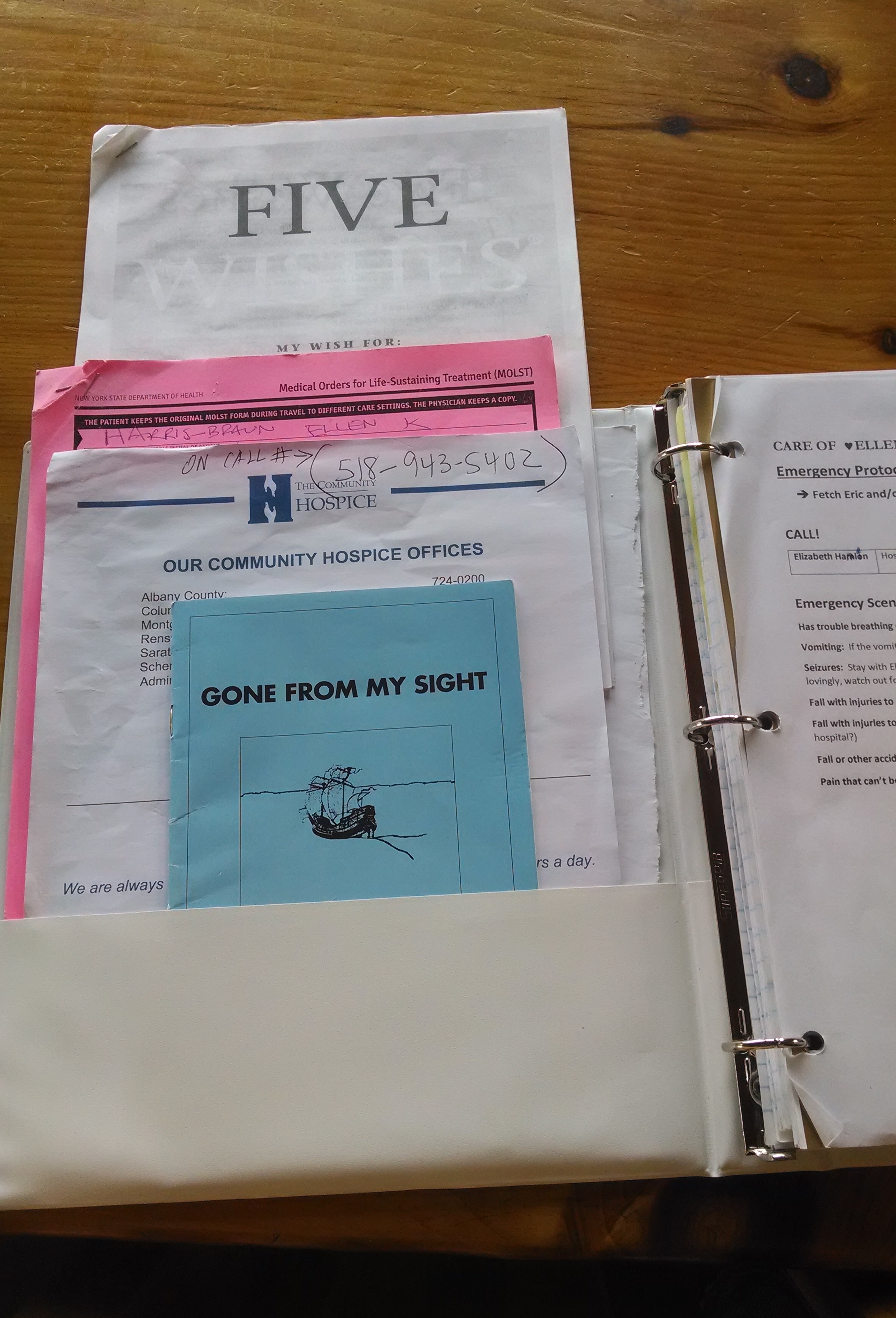
White Binder and Purple Pen - The front cover presents Key Information. Inside the front cover are Important Documents like Ellen’s MOLST, and the sections include emergency protocols, medication information, the daily care checklist, the log, the list of folks in the rings around Ellen and contact info, and more. The contents of the binder grow steadily as we add a care checklist each day and caregivers get more comfortable with writing anything and everything in the caregiver-tools10log that might be of use to other caregivers.  It turns out the log serves other purposes, one of which is to help an individual caregiver decompress after time with Ellen, even dump out one’s thoughts and feelings in a cathartic way.
caregiver-tools11

Oh, and then there’s Being Mortal: Medicine and What Matters in the End, by Atul Guwande, a timely gift from Birdie to Ellen and Eric last year, with Ellen’s penciled notes throughout.


… Spee over to Eric …

One thing I struggle with is that “charting” (of sleep times and med times, and other details of care) creates a map of a territory. On the positive side, this map helps us navigate the territory of caregiving, of sharing and coordinating information among caregivers so that, for example, we don’t give Ellen too many or too few meds. But, all maps have the property of both being incomplete and also modifying and feeding back on the territory they map. For example, the map can distance us (as caregivers) in sometimes subtle ways. One way is simply in that we spend time on the map that we might otherwise spend observing or engaging with “territory” itself. So in the most pathological case, because what we measure for this map is sleep and meds and a few other bodily functions, then the map could come to fill our entire consciousness of what Ellen “is.”

I find myself needing to tread this one carefully, holding the map for what is is - a tool - but always focusing on the territory first. For example, where/how does our map indicate our progress, as caregivers, in letting Ellen go?  Does the map itself, in fact, act as an unwanted tether? All territories, despite all the maps we make, remain a mystery.  Thank goodness.

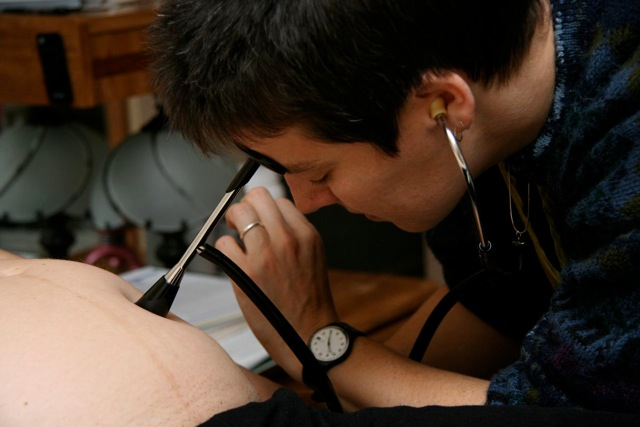
Here’s a famous picture of Ellen using midwife caregiving tools.

The Gifts of the Death Midwife

by Spee

Ellen has been sleeping away the hours, in the wheelchair, in the rocking chair, and on her bed, the bedroom couch, the office couch, and even her mom’s bed. When she’s awake, she’s often up and about, traveling in the manner we’ve previously described but no longer packing up. She’s also talking a lot less and we miss her wit. In addition, she came down with some kind of infection yesterday, with swelling, redness, and pain on the right side of her face and neck. The doctor, nurses, and Eric are trying to figure out how best to keep Ellen comfortable in the face of this new development.

Last winter, Ellen began asking her dear friend and colleague Shivani if she would be Ellen’s “death midwife.” During the spring, Shivani queried Ellen on what she imagined a death midwife would do. Ellen didn’t provide much guidance, but Shivani has done an incredible job feeling her way into this role. She creates and holds sacred the space around Ellen, she lifts up the beauty she sees in Ellen even as illness wreaks havoc on her body, she provides hands-on care of Ellen’s body, she prepares her emotionally for dying, she helps ease Ellen’s journey in any way she can, and she comforts and assuages fears and guilt not just for Ellen but for all of us. She is guiding Ellen’s way out of this world the way she guides many babies into this world. It’s so interesting to hear her and other midwives speaking of the similarities they notice in these two life passages. Early this morning, Shivani wrote:

... Yes the absence of her wit is different. I was just thinking how challenging it is that most of what she has to say is in some defense of her body. Don't move me... No that way... Can we just wait a minute... I want so much for her to die feeling loved and held. But as with birth, and most things, sometimes it is our job to merely be witness and quietly shine our hearts like a steady light.
Ellen would want to provide you with more resources on this topic of death midwifery, but there's not much available yet in the U.S. culture. More common is the death doula role - see Dying is hard. Death doulas want to help make it easier.

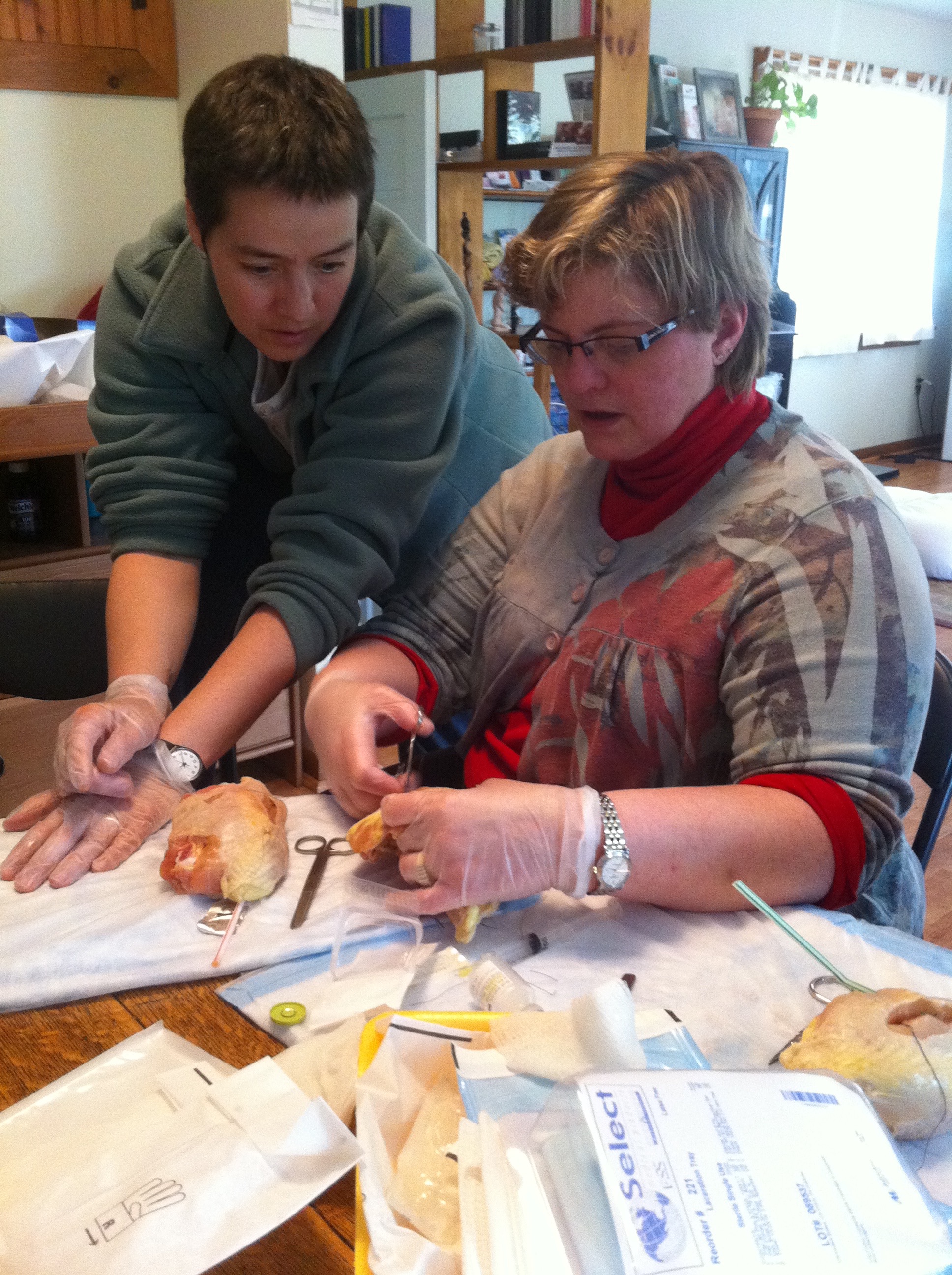
Here is a photo of midwife Michelle teaching Ellen to suture.

ellen-michelle-suture-practice

Packing up

by Spee

Sunday marked Ellen and Eric’s wedding anniversary and quite a few of you may remember that wonderful gathering on a crisp October day 22 years ago.  We’re blessed these days with bright and sunny weather that brings beautiful light and color into their home and offers lovely sights out the windows – soaring birds, deciduous trees tipped with bright colors, happily grazing sheep, horses, and white-tailed deer.

For days Ellen was restless, touring around the upstairs of the house, going from place to place in the wheelchair (with help) and moving items here and there, sometimes with an evident purpose and sometimes not.  At one point earlier this week, she was on the go for 22 straight hours before finally falling into a deep sleep.  Since then, she’s still driven to be on the move - she’s been spending quite a bit of time packing her bags - but with a bit calmer pace now and much more rest and sleep in between.  Whew, say the primary caregivers (husband Eric, mom Kathryn, sister Anne, and friends Anne and Shivani).

While it seems Ellen’s arms and legs are staying relatively strong for all that restless activity, we’ve noticed other changes in the past week, notably Ellen has more discomfort, more confusion, increasing difficulty swallowing, and more labored breathing.  Working with the hospice nurse, who’s checking in daily, we’ve responded by moving away from medication in the form of pills and offering more liquid pain medication and temporary boosts of oxygen.

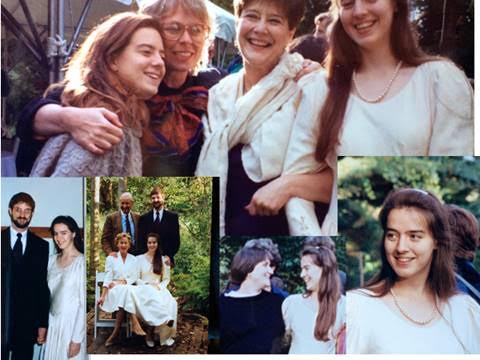
weddingSo it continues, with Ellen’s inner core shining through to us from time to time as we seek this way and that way to make her journey as comfortable as possible.  As you can imagine, we have many moments of sadness, yet we are lifted by and so grateful for Ellen’s sweetness, her smiles, her waves “hello” and “goodbye,” and her wit.  Yesterday when sister Anne was the caregiver on duty, Ellen got from her wheelchair to bed by herself before Anne could get close and assist.  Anne told her she should have waited for her, and Ellen replied in a sing-songy voice, conspiratorially, “Don’t tell Mom!”

Here are sweet photos from Ellen and Eric’s wedding day in 1994.

Maudlin?

by Spee

Ellen has always liked to do projects. She’s always had a list of projects going and the most recent one hung out the entire summer on the end table next to where she would sit on the living room couch. Recently, Eric, Kathryn, and I reviewed that list, made in April, and began assigning the projects not yet crossed out. Here’s a sampling:

  • Buy new spoons – replacements CLF31 by Cellar, plume @ tip, Tools of the Trade
  • Update the BCD trans.html page
  • Midwife of the Soul (Eliz)
  • Eric’s paper
Ellen has called management of her health while living with metastatic breast cancer the “Ellen Project.” What a complex project, with a dozen symptoms, multiple immune-system boosting activities, a dozen health care providers, a dozen medications and another dozen supplements, and over a dozen brain mets to track and manage. As she has become less able to manage the Ellen Project, others have had to step in. We have come to know numerous details about her medical case, including what might be causing what (such as a headache) and how best to address it (need to taper steroids more slowly?). We have not completely replaced Ellen’s brain in managing the Ellen Project (no surprise there), but we are doing okay – maybe we get a “B” while she always gets an “A” (see Ellen's Report Card).

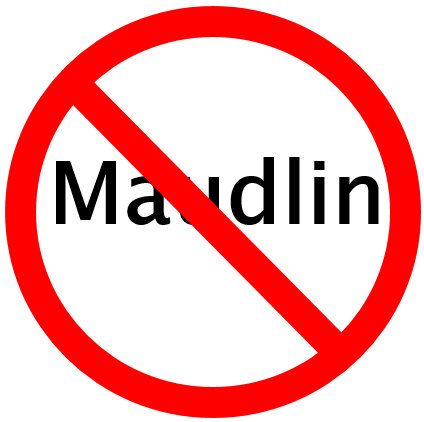
The days are getting more difficult and the nights are no longer very restful. Ellen seems uncomfortable a lot of the time and we’re facing that challenge of balancing enough pain medication (morphine) to make her comfortable with little enough medication that she’s alert enough to interact with those around her. Ellen has said lately that she’s tired and at the end of her rope. And yet, she has not wanted sympathy and certainly not pity. She has not wanted good-byes. She’s expressed discomfort at “this is what you’ve meant to me” letters received in the spring and summer, but also read them with pleasure while thinking of the meaning of her life and her life accomplishments. One thing is for sure – she doesn’t want maudlin* and doesn’t want us doing maudlin things. Whatever you do, don’t launch into the song Dear Friends.** If she had the energy, I could see her creating and putting up a sign such as this one:

maudlin3

Favorite quote of these past few days: Eric says, “I’m going downstairs to get some breakfast and I’m going to leave you with Spee.” Ellen replies, “Can I keep you on retainer?”

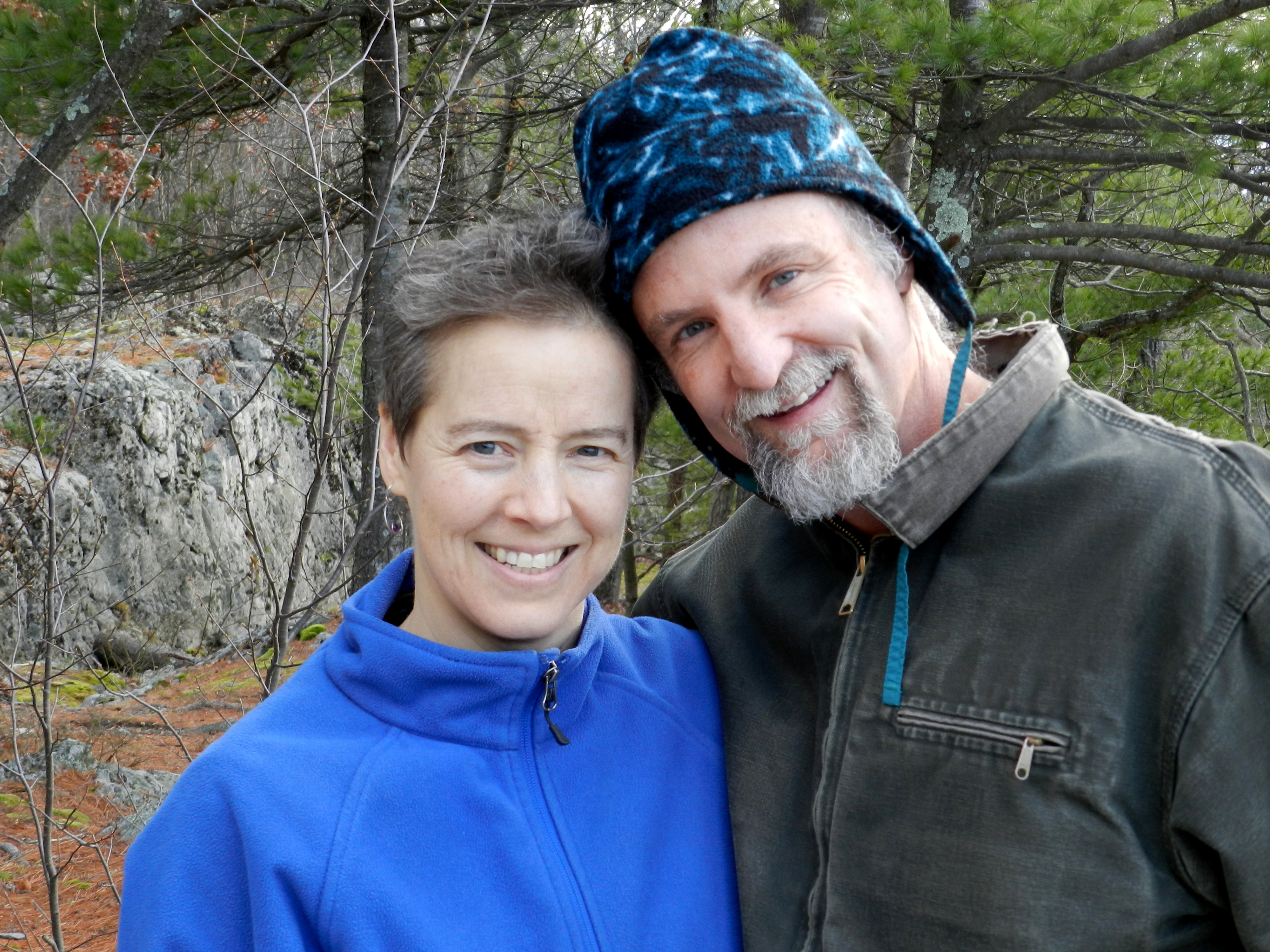
christmas-2014-ellen-and-ericWe’ve been sorting through hundreds of photos and finding one after the next of Ellen’s beautiful face. Here is one of my favorite photos of Ellen and Eric, taken at Dorson’s Rock above Powell House during a family outing that included not very successful efforts to send paper airplanes flying off the edge of the cliff.

With gratitude today for Ellen’s warm smile, for shared therapeutic Colorku*** with Kathryn and Anne as we accompany Ellen and Eric during this long labor, and for QIVCers coming together at this time to hold us all in our collective hands and hearts.


  • Definition: Showing or expressing too much emotion especially in a foolish or annoying way, weakly and effusively sentimental ** Lyrics: “Dear friends, dear friends, let me tell you how I feel, you have given me such treasures, I love you so.” *** A game like Sudoku, with colored round balls instead of numbers

Shifts and Changes

by Eric

Things have shifted quite a bit for Ellen in the last two weeks, with notable further cognitive decline (mentioned in her previous blog post) and turning inward.  Ellen spends most of her day resting with her eyes closed and will open them in response to a greeting and sometimes engage a bit with whoever has appeared, although often she is not lucid and/or not able to get out the words.  Hand gestures and facial expressions are becoming important modes of communication.  However, from a few on-point contributions she’s made to conversations going on around her, we can tell she’s listening and still has her sense of humor.  When Spee told her, “I’m just removing this bug from your grapefruit juice,” she replied, “That’s probably the only protein I was going to get today.”

Indeed, Ellen is eating and drinking very little now.  In recent days, she seemed to have less pain, discomfort, and nausea, which is a relief.  She does get up and around a bit, although her mobility is decreasing steadily.  On the list of “no longer doing” are using the computer, looking at her phone, reading, and getting tasks done like putting stuff away in its place.  However, when something is out of place, she’s still pointing and giving us a meaningful glance and is clearly satisfied when we take the appropriate action.

As of three weeks ago Ellen started a “chemo holiday” as the side-effects just became too much to bear.  This last week we’ve had lots of discussion about starting hospice soon, which will probably happen early next week.  Those of us caring for her have been reviewing her “Five Wishes” document (advance directive) about end-of-life wishes for how she wants to be made comfortable, how she wants people to treat her, and what she wants her loved ones to know.  She wrote, on the one hand, “As I am dying, I want people to be informed as to what is happening.  Clarity and frankness about the situation as it unfolds is very important to me.  My loved ones and friends should be able to find out what is going on with me, to the extent that they want to know,” and, on the other hand, “I hope that my loved ones can come to remember me for what I was like before I became seriously ill, rather than just remembering the last part of my life.  I want them to remember me living rather than dying.”

We are grateful for all the thoughts, care and holding in the light that we feel from all of you coming our way.

-Eric & Spee

Back to the grind

by Ellen

Coming to you live from the chemo suite! Our trip is over and we’re slowly getting back into the patterns of normal life.  Which of course include chemo.

It seems like Jesse grew an inch while we were gone. They are interested in helping me out, which is fun. This afternoon they pushed my chair for a bit because Eric had to park the car instead of coming in with us. I wanted a picture.

"hanging in"

by Ellen

That’s what I tell inquirers when they ask how I’m doing and I have nothing to say that is particularly interesting.

So over the past week it’s been pretty much like that, except for good news from my recent MRI and CT scans: nothing known to be new; nothing bigger than last time; lots of things–and by things, we mean tumors–that stayed the same size.

Maybe some other notable things happened this past week, but I just don’t remember them at the moment. Chemo is weakening my memory for sure. However, at least now you know that I am still around and still hanging in. Or a reasonable Internet facsimile is.  But ouch.  Would a mere reasonable Internet facsimile have such intense back pain and complain about it this much?

Guest post: Spee’s update

by Ellen

Spee sent out this update last week by e-mail, and I thought it was worth putting on the blog to fill out the picture.

Hi, family and friends -

It’s been a while since I’ve sent out an update because of more frequent blog postings by Ellen and some awkwardness there.  But today I spoke with her about this and described the need, and she released me to update you all freely.

What’s happening first and foremost is that Ellen is slowly but steadily declining, but still hanging in there.  She is increasingly tired and disabled, with decreasing stamina, more frustration and anger, reduced cognitive functioning, and more withdrawing.  These are small increments but especially noticeable to those of you who see her less often than I do. 

Ellen spends much of her time in bed, but tries hard to come down for meals and occasionally do fun things like go for ice cream or to an event.  Of course, she has many medical appointments and she is able to get to most of these, with Eric or Kathryn or someone else as driver and companion/helper.  She uses a walker that has a seat onto which she can rest whenever she wants, and that helps a lot.  She has a wheelchair, but really doesn’t like to use that.  As you may have seen, Eric rented a scooter for her use in Montreal and that worked out quite well (see the recent blogpost about the trip).

Ellen is now taking methadone regularly and one question is how much that might be contributing to her increasing tiredness and other worsening symptoms.  The visiting nurse Elizabeth says that methadone could be a factor, but the most influential factor is likely the week after week, month after month doses of triple chemo.  There could also be disease progression as well, she says.  In addition, Ellen’s broken foot is healing slowly and still causes pain, which gets her down.  Ellen is committed to continuing the chemo as long as it’s keeping the cancer in check.  This coming Tuesday she’ll have the routine scans to see how that’s going.

In other news, Will is enjoying his summer grounds-keeping job at Buxton School.  He comes home most weekends and brings upbeat energy into the household.  This morning, he, Eric, and Jesse were happily making a big brunch while music blared in the background.

Jesse is home for the summer and spends much of their days in the basement on the computer.  They also watch TV with Ellen about once a day, with the two of them enjoying snuggle time and conversation about what they’re watching.  Jesse has lots of appointments that get them out of the house and they have a volunteer job they really like, which is volunteering once a week at a wildlife rescue center. 

Eric is tired and he requests that people stop asking him, “So how are YOU doing?”  He is taking care of himself by running regularly, taking one 8:00-8:00 day off each week (what we call Woodstock Wednesdays, currently with Helen and me covering), and playing squash at Simon’s Rock on Mondays and Wednesdays while Anne and Sandy are covering dinnertime.  He continues to prefer to spend a lot of time with and caring for Ellen over working or doing household chores, so the help that others are providing the family is generally in the realm of household functioning.  It seems they’re ready for the extended circle to start contributing dinners once a week, and Sandy will arrange this with Chris De Roller.

As for Helen, Gene, Jens, and me, we gained access in May to more people trained in hospice and available to those around Ellen, even though she isn’t on hospice.  We’ve benefited from time with both a social worker and a chaplain, who are part of the same team as Elizabeth is on.  We also have super help from Maizy, who’s working about 25 hours/week supporting Helen and Gene mostly with driving and our household mostly with kitchen duty.  Natalie and Aaron also step up and step in in many lovely ways.

The "Rings Fellowship" that Emilie or Dee hosts every other week is super helpful.  We continue to be extremely grateful for that. 

I’m also grateful that Ellen is keeping some sense of humor, as we sure need that, and that she finds joy in looking out over the lovely meadows and forest that surround us.

While I’m on a gratitude run, I’ll add that I’m grateful that Jens is staying centered and spreading love, that Eric is maintaining his stamina and wonderful spirit, and that Elizabeth is such a terrific hospice-trained nurse that she can hold the most difficult conversations with Ellen.  I’m grateful to Kathryn, Ellen’s sisters, Helen, Gene, Sandy, and others who are constantly thinking with deep love about what else could be done for Ellen, Eric, Jesse, and Will.  And thanks to the rest of you for your waves of love and Light.  You make the journey lighter.

Love,

Mommy/Spee

End of today

by Ellen

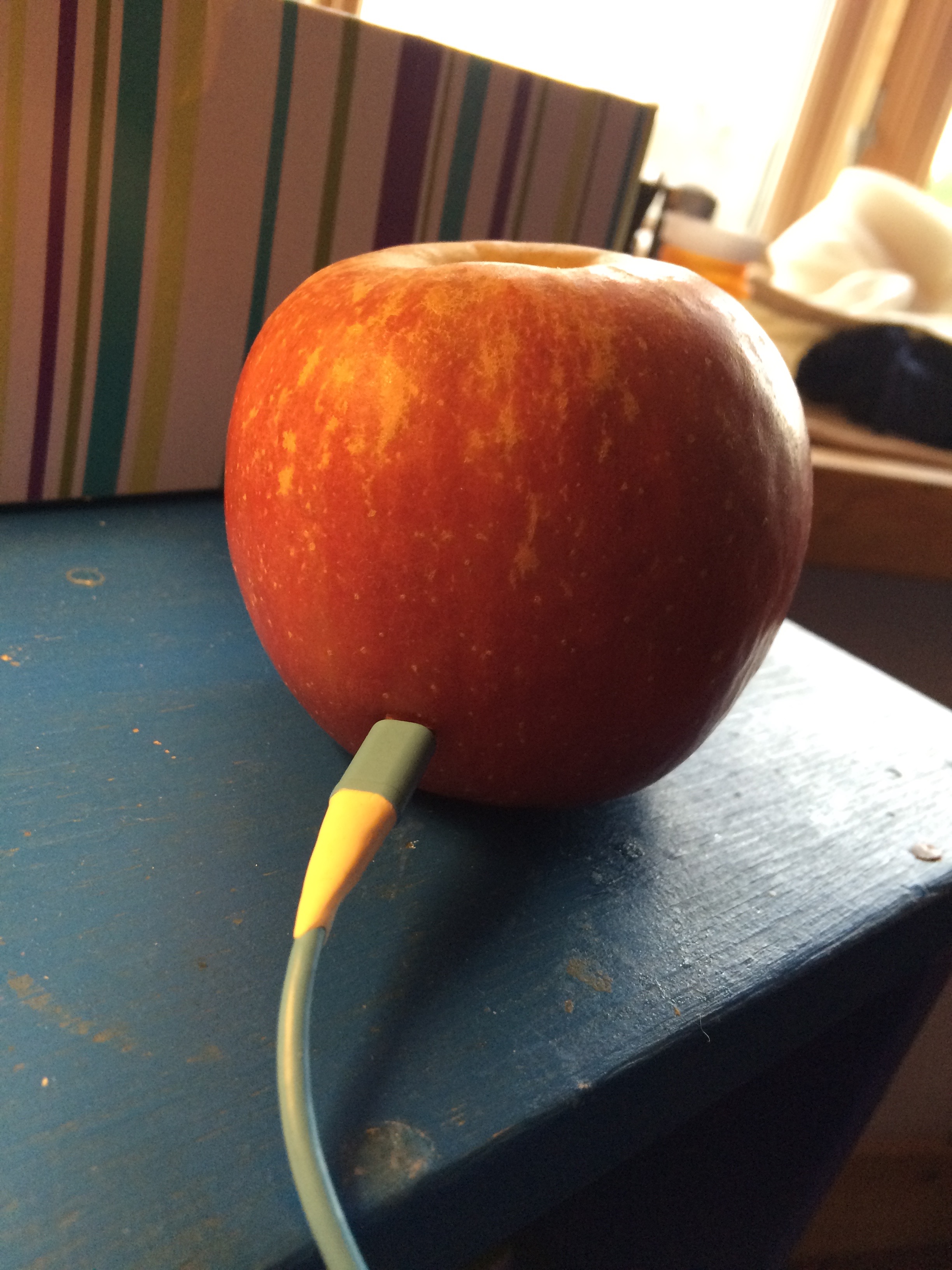
Charging my apple Charging my apple

Today’s chemo was the start of some cycle or other–9th intrathecal methotrexate maybe, and 6th carboplatin & gemcitabine?  I am not keeping track right now. In fact for the last week or so I have not only been deeply physically tired but also very ungrounded on day of the week, day of the month, the month itself.  My routine at NY Oncology Hematology keeps changing and I am just having trouble keeping up with things.  Like, is it April or is it March still?  Or possibly it’s already June?  Yikes.  Hope the fog passes over soon. And noticing how dependent I have become on the iCal app on my phone.

Cerebrospinal fluid is still coming back clear–no more cancer cells circulating–so that’s continued good news.

Today we were at NYOH from 1:30 to 5:00.  Whew!  Blood draw for lab work, visit with the Nurse Practitioner who works for my oncologist, IT chemo, then regular (through the port) chemo, then finally all done and out the door at 5:00.

I got right in bed because I could feel I needed REST.  Getting better at realizing that, maybe, instead of trying to power through it.

Asking and asking and asking for help large and small

by Ellen

orange being peeled for me orange being peeled for me

When I found I couldn’t peel an orange or a grapefruit anymore (I like my grapefruits eaten in sections like oranges) I started working on how to cut them into sections so they could be tackled with only one working hand. That was not so easy–it was pretty messy and wasted a lot of juice on the counter–and took a cleaver and an acceptance of some pretty weird-shaped slices. After a month or two of this I saw someone at our QIVC retreat peeling an orange so I asked if she could also peel me one. Which she did. And I ate it in sections instead of tearing pulpy pieces off slices of peel–and (heres why the blog post) it was so much more delicious and enjoyable! I had forgotten. I had settled for the self-sufficient DIY method that brought me noticeably less pleasure.

I assume no one out there in healthy-person-land, world of the well, wants to peel my orange for me.  But I think this is wrong in general.  People wish they could help, change things, make a difference–and this is one thing they can do for me, I guess.

Reality check

by Ellen

Surprisingly I don't think that often about the high chance that I'm going to probably die pretty soon from this cancer. I try to think about it, but it's really hard to conceive of, even when given a life expectancy that is measured in months.  How to believe in that? *Why* believe in that?  I don't really know how it will go and it is hard to believe, I guess, even for me.  But then I step back a little bit and catch myself stumping around the kitchen, say, after breakfast—trying to do my part to clear the table—and I walk like a penguin and I almost fall down and I am breathing hard don't have any energy.  This is *not* a healthy person.

So I walk to the fridge and put something away, walk back to the table, and walk back to the fridge and I'm panting.  I don't have any energy and have to rest, but then I don't always rest because I'm stubborn so I end up wearing myself out like this many times a day.  This morning after breakfast I decided to come up to bed again and sit and read so I had to get all the things I needed to do that and then come upstairs, which is hard these days.  Then I remembered I would want the phone if it rang, and then I needed water, and then I needed to take a morphine, and once I did all that I was just staggering around like a drunken penguin because I just had no energy and could barely get myself to move around. So then I plopped into bed and waited a little bit before I could swing my legs in because I was so tired.

So I keep wearing myself out and I don't notice all the time how far I am from being a healthy person.  Then some kind of reality check sinks in, like being offered a cut in the bathroom line at the movie because I have a stick to help me balance and I am obviously not healthy. Oh.  This is me they're offering special treatment to?

On paper right now things look okay.  The chemo we started in December and early February are both working, it seems like from the CAT scans and MRIs, and so on paper my cancer is ‘responding to second-line therapy” blah blah blah but then in my real life right now it seems really hard. Maybe more for emotional and psychological reasons than physical, but the physical – particularly fatigue and trouble walking – is pretty tough right now.

Vanities: smarts

by Ellen

(Part four of four musings on vanity’s role in my life.)  Finally we come to my final vanity: Vanity about smarts.

I have always considered myself a smart person.  Besides this, I have had to navigate in the medical world,  specifically the world of breast cancer, on and off since 1995.   Before my diagnosis of metastatic cancer in November 2013, I had been in graduate school for midwifery for a while – wondering if some courses, like pharmacology, were ever going to really come in handy in my life as a homebirth midwife.   The midwifery program involved a lot of researching studies, learning how to critique them, and understanding the value and limits of statistics. So when I had to switch my focus from midwifery to cancer, it turned out that all of this grad school stuff was hugely useful.

It is important to me to keep track of new studies that might be relevant to my case, which makes a lot of sense because we might find something useful that way. But for me it’s also about showing my doctors that I am comfortable in their world and using their language and jargon.  When I meet a new doctor,  it doesn’t take long for me to use a big medical word or otherwise indicate that I have some medical background;  I can see people changing how they talk to me after that.  I seek out doctors who like to teach; that means they are open to questions and being questioned, and will be patient with my need to go deeper into explanations and probably a lot of patients want.

Two things made me notice this vanity of mine about smarts: last summer, faced with a variety of weird symptoms that started all at once, I figured out that it was related to the vagus nerve. My oncologist and others gave me other explanations, but they didn’t make as much sense to me based on what I knew about the vagus nerve and what had happened in my body.   Eventually I went to an ear, nose, and throat specialist  who put a camera down my nose and looked at my vocal cords. Based on what he saw and what I told him about my symptoms, he confirmed that the vagus nerve had caused the problems. I was probably the only patient he saw that month who high-fived her husband upon being told she had vagus-nerve damage.   But I was so pleased with myself! I had figured it out with my knowledge of anatomy and physiology and my careful observation of my own symptoms.

Then later in the year I got pneumonia. One day I felt really rotten and short of breath without knowing what was wrong; the next day, when I went to chemo, I insisted that they checked my oxygenation level even though they don’t usually do that along with blood pressure and temperature.   The number that the pulse-ox machine showed  got me a quick ticket to the emergency department instead of chemo that day, and I was admitted for treatment for a few days. What makes me a bit proud about this is that I figured out something was wrong pretty early in the disease process, so I wasn’t too miserable and it was pretty easy to get rid of.

Another thing we did with smarts (Eric helped) was to create a spreadsheet to track my brain mets.  The written reports were hard to  compare and I noticed the radiologists who were writing them were sometimes failing to write follow-up notes on mets that had been seen in a previous scan and listed in a previous report.  Tracking the mets this way just seems more organized–thus less likely to lead to mistakes–so why not do it? Since the doctors won’t, I do.

So I feel pretty vain about being smart in this realm that I am forced to inhabit.  Sometimes when I don’t feel energetic enough in the brain to engage at this level, I wonder how I will adapt if I ever lose the sharp, medical-smarts part of me for good.  I know there are cancer patients who do none of my self-education and don’t ask a lot of questions, and that must be fine for them.  But for me the educated back-and-forth and discovery of interesting new studies is part of this whole experience–a part that buoys me up.

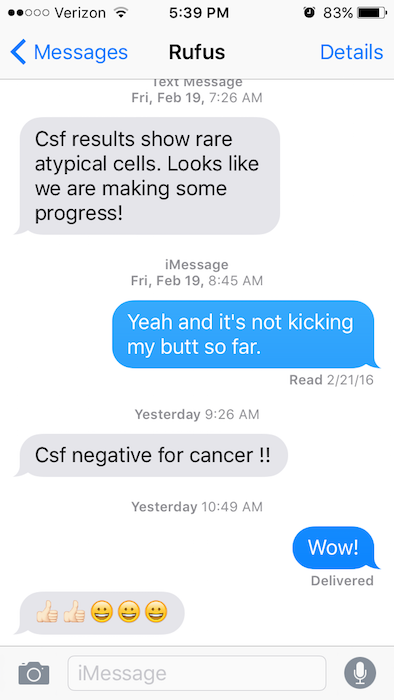
IT Methotrexate is working!

by Ellen

I’ve been getting intrathecal methotrexate (methotrexate injected into my cerebro-spinal fluid) for about a month now, which makes for a busy chemo schedule twice a week in Albany along with my other chemo regimen. But it seems to be working!

Texting with my oncologist Texting with my oncologist

I don’t know what this means for my chemo schedule in the next month or so, but I I know it’s good news.  Only half of patients respond to methotrexate at all, so I’m in that half, which is great.  Now median survival is seven months, with 15% of patients stretching that out beyond 12 months.

My report card

by Ellen

Recently a few of my closest family members and friends got together and wrote up a report card for my recent course load at the University of Oncological Resistance (UOR).  It is pretty funny so I thought I would share it.:

Ellen's report card

Today is “quick” chemo (just methotrexate) and my stepsister Deb, who is visiting, is taking me.  Then we will stop by the Honest Weight food co-op in Albany to get ingredients for all the yummy things Deb is going to cook for us.  Wooo!

I am still really fatigued most of every day–I assume it’s the demanding new chemo schedule.  Hard to adjust to, and I hope it’s just a phase.