Posts

The evolving bucket list

by Ellen

Originally my sparse “bucket list” featured taking my family with me to the bottom of the Grand Canyon, where I had been but they had not.  Then there was spending relaxed time in France, which we did for almost two weeks last summer; and I wanted to go to England again, too (which I did last September with my mom and Spee).

Now the list looks like this:

  • Finish building a Little Free Library for QIVC and neighbors.  This is now 90% finished, thanks to this weekend's focused work by my mom and her friend Paul!
  • Get the decorative railing at the top of the stairs finally finished (by our builder friend Glenn). Designed by me years ago, it was set aside so we could finally move in! and finish it later.  It is now over five years later. :)
  • Go to Montréal on Amtrak.
  • Teach Jesse how to shift gears.
  • Go to Chipotle with Will! Never been there, and he really likes it.
  • Some more time in New Orleans with my mom (who lives there) and her cast of friendly characters.
  • See the barn swallows return to their summer haunts around our house and build their yearly nests in our eaves.
Seems doable!

Weekend update

by Ellen

No, not that Weekend Update!

Dealing with Fatigue:

Boy, do I sound tired! Possibly more tired in my voice than the rest of me.  I did notice today that my voice was really weak, so you are getting to hear what that sounds like.  Not much like me, at least to my ear.

Post-chemo report

by Ellen

Today was almost completely taken up with “double chemo” along with a day-one-of-the-cycle appointment with the nurse practitioner who works with my oncologist. My oncologist is on vacation–and I hope he is vacating enough because he’s got to last me and not burn out!  How is that for thinking long-term?

I still like to think of these chemo days as pampering and “spa” days. I can ask for pillows and warm blankets and stuff from the nurses, and I know a lot of them by now somewhat, so the infusion suite is a friendly place to spend a few hours.

Seems like the first day in each cycle of Thursday chemo (Gemzar & carboplatin) is about four hours long, start to finish.  That includes blood work and an appointment with a practitioner before chemo.  And intrathecal methotrexate afterward.  today we left the house at 11 and returned at about five I think.

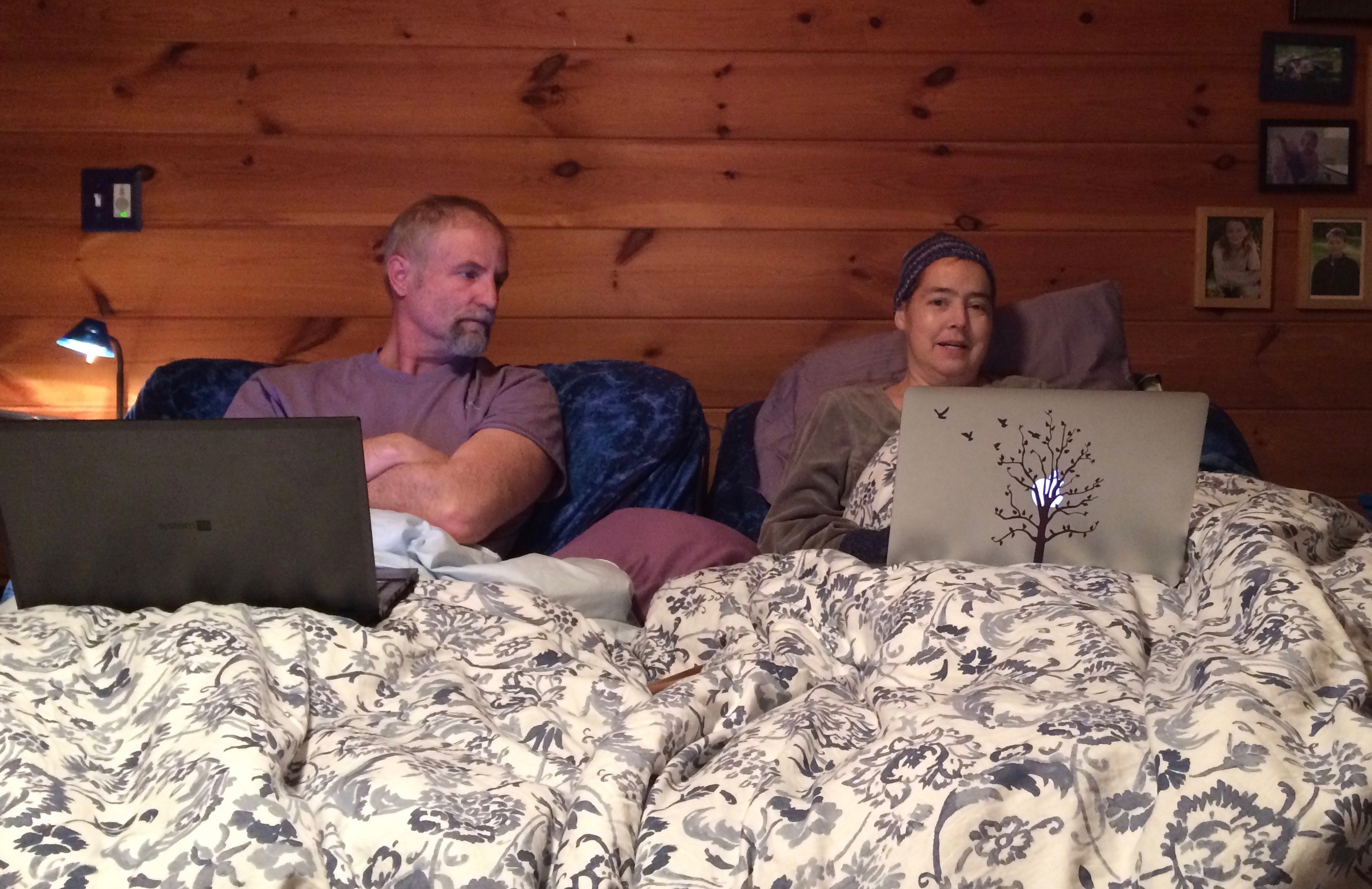
I felt like hopping into bed and invited some of my associates to watch a stupid movie with me. It was really stupid. I have a small headache and just feel kind of punky, but no nausea or queasiness – all that anti-emetic premedication really works. And in fact I am looking forward to eating some dinner.

Meanwhile, back at home, if you hold your arms just right…

IMG_5918

…Look what you might catch!

IMG_5917

"Quick" chemo today

by Ellen

A bit about today’s trip to Albany Med:

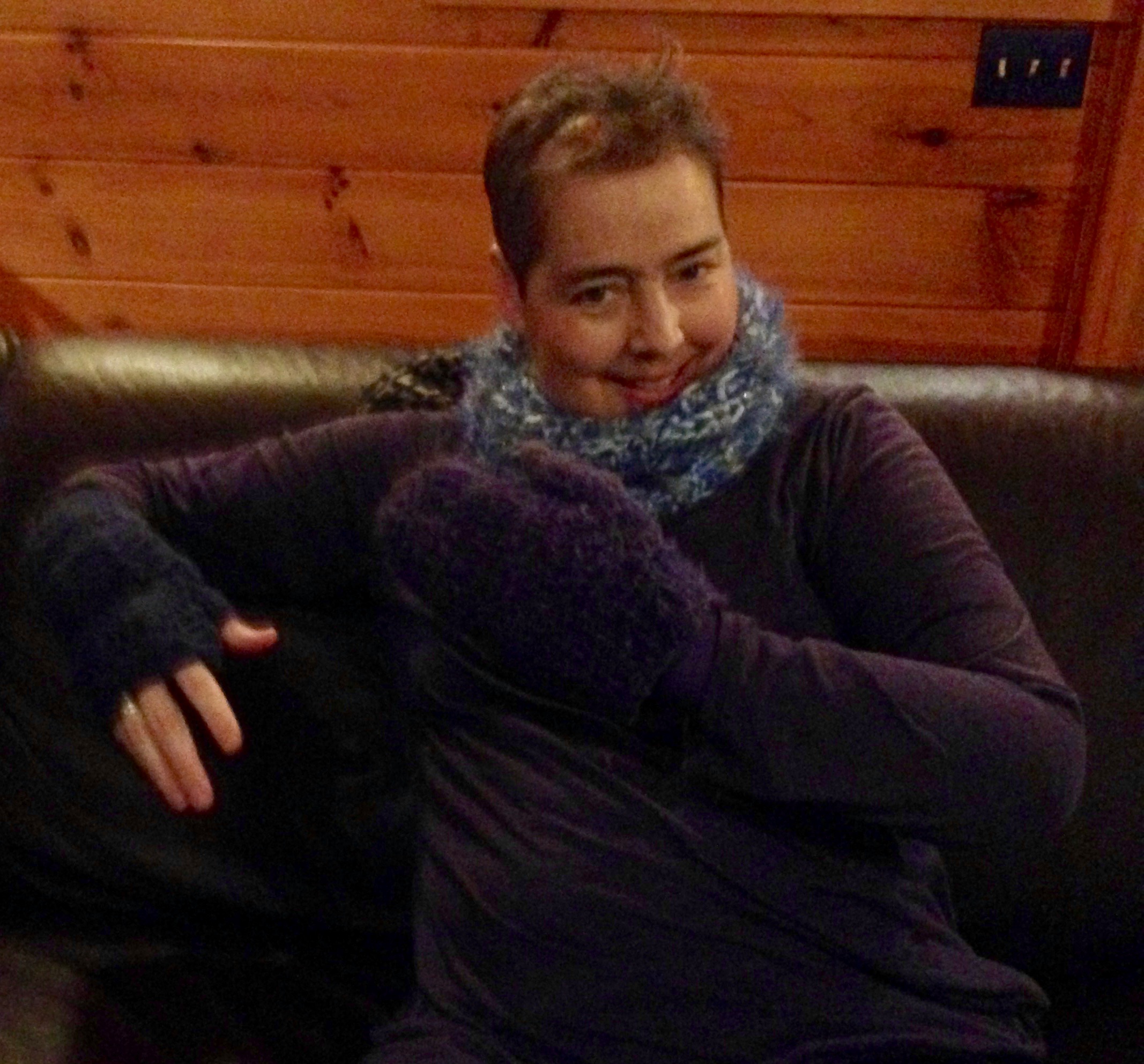
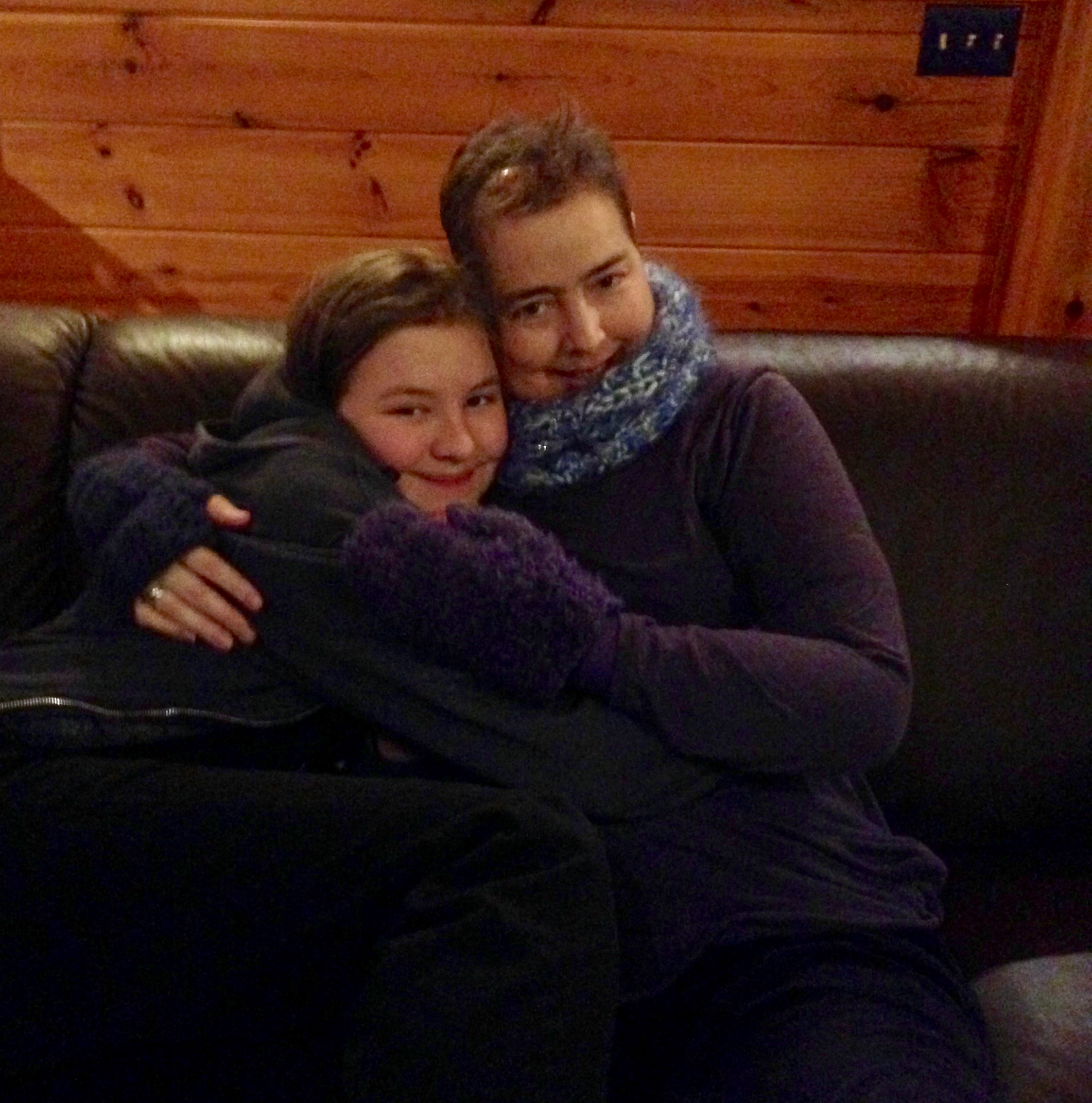
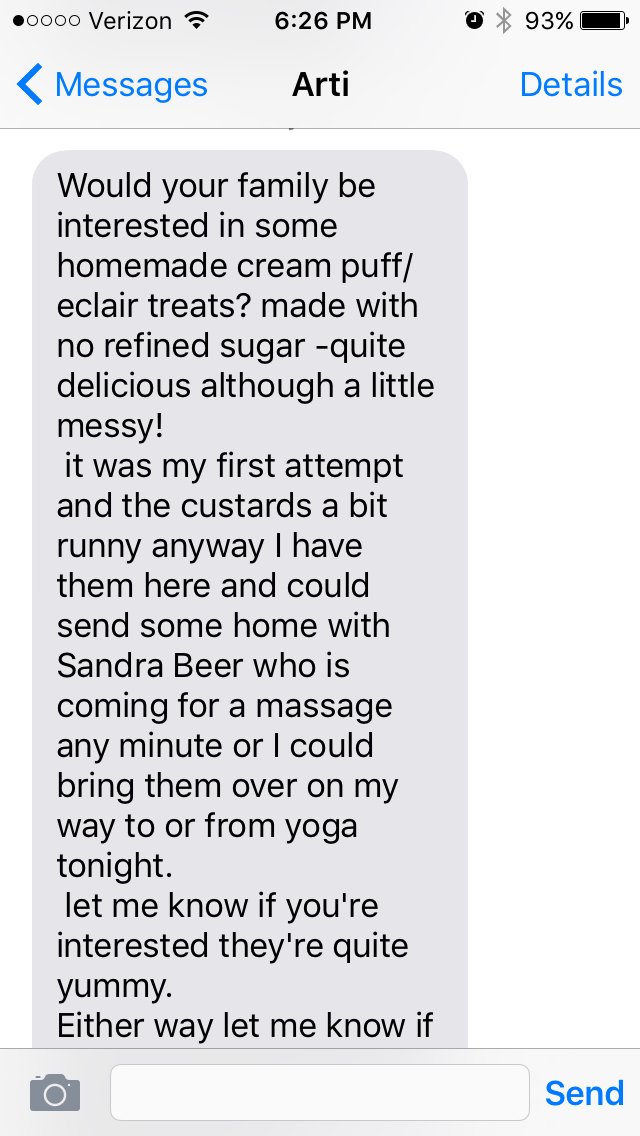
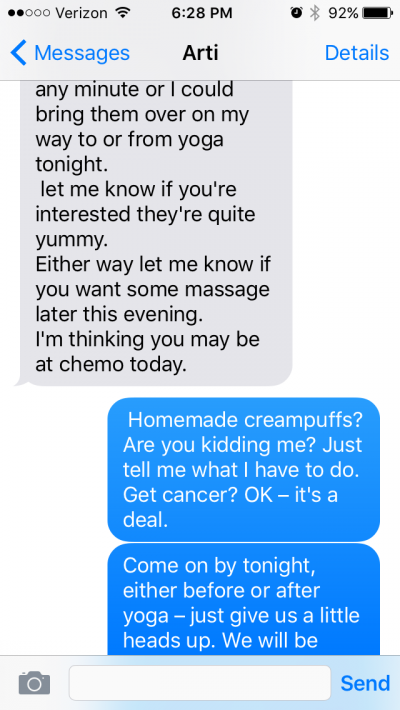
Late this afternoon, after Jesse and I watched some episodes of “Elementary,” our friend Arti stopped by with some homemade creampuffs.

IMG_1525

And I replied irreverently:

Death Straight Talk (by Eric)

by Eric

When your wife has stage 4 metastatic breast cancer, and has been hospitalized once for an upper extremity DVT, once for pneumonia, another time for malignant pleural and pericardial effusions, has had small pulmonary emboli, and then gets diagnosed with leptomenigeal carcinomatosis, and you also live in a world that has Google, so you can type in those terms (or worse click on the links some idiot put in a blog post) and get very detailed descriptions of these diagnoses and, more importantly, their prognoses, then, despite the doctors not coming right out and telling you so, you kinda have to face it that the most likely hand you’ll get dealt this year is to watch her die. Not just the mostly likely hand, but the most likely 99 hands.

We’ve tried from the start (of the stage 4 diagnosis), before the more in-your-face evidence (which for me was the hospitalizations) not to live in denial, and not to keep things from our two teenagers or our family or community. To make decisions taking this possibility/probability into real account. But this turns out to be much more difficult that I expected.

DST stickerSo this post is about a concept called Death Straight Talk (let’s call it DST. That way it sounds like the more familiar “DNR”). There are three arenas in which I want to talk about DST: 1) the medical world, doctors, nurses, and Medicine as an institution; 2) family, friends and community; and 3) the metaphysics of probability and how we think about our future. So here we go.

1) DST in Medicine: Hospice operates on an agreed-upon basis of DST. The idea is that “there’s nothing left to do” to prolong life (meaningfully), so shift the medical care to comfort, pain control, and getting the most of out each day. A Do Not Resuscitate (DNR) order is another form of DST in medicine, where the patient gets to issue a token that goes in their chart saying something like, “Look, I’ve thought this through and I’ve come to the conclusion that death is preferable to life after resuscitation, so let me go.” These are both DST items that have been embodied in institutional practice, the first at a more macro level, because, it turns out, Hospice care ties in deeply to the structure of how and what things get paid for and who gets to decide. (This in itself is worth a whole other post, but life’s too short for me to dig into that.) The second is at the more micro level, because it’s just about what to do under certain circumstances for an individual patient, whether in hospice or not.

These two patterns, Hospice and DNR, are formal recognition that near death, things are different, and we have to act differently. But now to my direct experience: despite an ominous prognosis, Ellen’s not at either of those two points yet, and so, institutionally, there’s practically no DST. It’s like a binary switch: either we act like you won’t die, and plan our doctoring on that, or we finally give up and off you go to Hospice. Here’s how this plays out. Hospitals are places full of protocols: vitals every 2 or 4 hours, neurological checks every hour, gotta pee before you get discharged, NPO (nil per os – no food or drink) before surgery, start a bag of fluids for practically anything, keep for observation for two days after X surgery, don’t go off the floor (or out of the ward doors), and on and on. Lots of protocols, mostly in place for good reasons.

But here’s the question: if you might have only 4-6 weeks left of life (if the current spread of cancer doesn’t respond to therapy) do those protocols apply? Should you really spend those two days under observation, living a substantial percentage of your remaining life in the hospital instead of at home? Should you really have that conversation you’re having with your family or friends interrupted so the nurse can write down your blood pressure numbers? Should you really have to spend the more than an hour a day (once you add it up) explaining your complex medical history over and over to each new nurse, resident, attending, etc., who comes to check up on you? Should you really get filled with IV fluids before a surgery to offset the dehydration risk that comes from the NPO protocol, which is there to mitigate the risk of throwing up under anesthesia, when those same fluids have a high risk – shown in the previous hospitalization – of causing swelling in your legs and feet which might make it painful to impossible to walk in your last weeks of life?

In our experience the protocols just don’t take into account DST. Here’s how I know: during our last hospital visit, I explicitly told nurses and doctors a story that approximately went like this: “Please treat us as if Ellen’s chart had a big DST sticker in it. It’s kind of like DNR but stands for Death Straight Talk , which, like a DNR, is treatment instructions for you from Ellen, but what it means is: first of all, we can, and do, talk about death straight, but second and more importantly, in providing your care, think about whether your actions are appropriate for someone who will likely die soon.”

The results of telling this story were clear: after some initial shocked looks, we got different care. The doctors let us go home “early” after Ellen’s Ommaya reservoir implant; we got “off-floor-privileges” while awaiting surgery; they didn’t make Ellen start on fluids at midnight before the surgery, etc. The humans involved responded deeply and with compassion to the truth that was embodied in a simple acronym: DST.

2) DST with family, friends, and community: If you want to create drama, lie. Lie explicitly, unconsciously, or by omission. In our case, we might call that Death Curvy Talk, or Death Denial Talk (DDT). The other night Ellen and I watched a dumb movie called “Meet My Valentine,” which is about a guy diagnosed with terminal brain cancer who decides not to tell his family but instead find a replacement husband/father for them instead. As a movie it was really dumb because that DDT was so obviously poisonous. But as a metaphor it’s revealing. If I look at where things feel twisty and drama-filled and out of whack, I see that I haven’t lived up to DST. As I said at the beginning of this post, we’ve tried to face things directly from the start. But something interesting has happened since the introduction of the DST acronym. As a token that we can refer to, it’s given us permission, or an opening, or something to actually get to to the straight talk more quickly. Now that it’s there, we invoke it. “Hey, I have a DST thing…”

Here’s a quote from an e-mail from a friend: “I wanted to offer to help, if need be, to begin/continue/whatever, discussion of burial, funeral directors etc. I have, unfortunately, intimate experience with this recently, as you know, and might be able to bring some perspective to this part of DST.” What a relief and and efficiency that this provides. It feels to me that the more I live into DST, the more this experience goes from what I call “dramatic” to what feels “powerful” or “moving.”

3) DST metaphysics and probability: Here’s the problem with DST. It assumes we know the specific future. Of course in one sense we do. All of us will die, we know that, but that’s hardly a specific knowing. So, using DST, how do we also talk straight about that one other hand of cards out of the 100–the one in which it turns out that Ellen recovers and later quietly dies in her sleep at the ripe old age of 103 well after I’m gone? This is the hard part for me. I used the metaphor that Ellen’s disease prognosis is like drawing a hand of cards. But that’s, at the very best, only a partially valid metaphor. Probability provides a great tool set for assessing aggregate outcomes, but it also can have the effect of deep dis-empowerment at the individual level. Just because your chances of getting breast cancer go up by X% if you have the BRCA1 mutation doesn’t mean that you don’t have any agency in whether it actually happens in your own body. From all our reading, it’s pretty clear to us that cancer as a bodily process is connected to the immune system, which is deeply connected to the central nervous system, and also connected to physiological terrain. So what power does that mean we actually have? I believe that diet, and stress, and my thoughts have an effect on “my chances” of getting cancer, and these are things I have control over. Bookstores, however, are filled with conclusions from this that to me are just magical thinking: that you can just think yourself back to health. But I also read and hear people jump to “don’t blame the victim” as soon as you mention the ways in which we do have agency. It’s kind of a double bind: if you believe in agency, then if you got sick or don’t heal yourself it’s your fault. But if you just take it as luck of the draw (i.e., not your fault) then how can you activate where you do have agency?

So to me this is where I don’t know how to have real DST. What is the “straight talk” that both acknowledges and deepens the agency we do have, and yet doesn’t fall prey to either magical thinking or blame-the-victim? Just because the odds are 99 to 1, does that mean we have to match the relative percentages of our talking time to those odds?

I don’t know the answers to these questions. But the core move in DST gives me guidance: open myself to what exists, or at least turn towards it rather than away.

Modern disease prognoses provide odds based on existing historical records: scientific studies. Open myself to them. But also the evidence of agency affecting cancer outcomes exists. Open myself to it. My pain and my joy in these days exists. Open myself to both of them. Paradoxically, denial and hiding and self-veiling also exist. So that’s OK, too; turning-toward will also periodically involve turning-away. This isn’t about some moral claim. It’s just a wish, a longing, perhaps a stance, to turn towards what I see in front of me. DST. Last words: just because I don’t wish to turn away from that which I do see, that doesn’t preclude me from turning toward that which I don’t see: all the potential branches of the future. Because what else is creation?

–Eric Harris-Braun
Chemo-day update

by Ellen

About today and my current chemo schedule etc.:

After all of this, I felt a little queasy and rested In the car all the way home. But then I walked from the parking area to our house, ordered some food stuff from Eric, and marched up the stairs wearing my back pack foot-over-foot like a normal person (1 foot per stair).  Also, Spee and I took a 15-minute walk on the road in the snow just before Eric and I left for Albany. So although I am tucked into bed right now, I am feeling like I had an energetic day.

That walking up the stairs with the fullback pack myself was a first since early December. Never discount how bad pedal edema can be for your strength and health, That’s my device.,

Speaking of advice, at the end of our time with the nurse practitioner, I offered again my attention as a midwife, since she is due with baby number two in April and not having a very happy pregnancy. So I didn’t push. But she took me up on it today and we talked about the recommendation that she be induced for this baby because her first baby came pretty fast. She lives 20 minutes from her hospital. It was a very fun conversation to have because I got to use my midwifery skills right on the spot.

Now I’m back to resting my brain and body in bed with Eric next to me.

Hair fun

by Ellen

Lisa and Aaron, who visited to help out (tremendously!) for the past few days, did the clay-dye job the other night in the bathroom with friend Anne while Jesse supervised from the bathroom shower.

Hmmm, I look a little tired in that last photo.  Yesterday was my fullest and most energetic day in weeks.  Shivani and I went to midwifery peer review, driven by Lisa and Aaron, who explored Saugerties.  Nowdays I pay the next day for days like that--just in fatigue.

Plans for the rest of the day: a visit from the palliative care nurse, and before that some craniosacral therapy with my friend Meg. Then maybe a nap or Netflix before dinner.

I am still working on those voice memos for the blog. Let me know if they don't work for you–hoping they are easy because they sure are easier for me.

Now for lots of pictures!  I am really enjoying pictures these days.

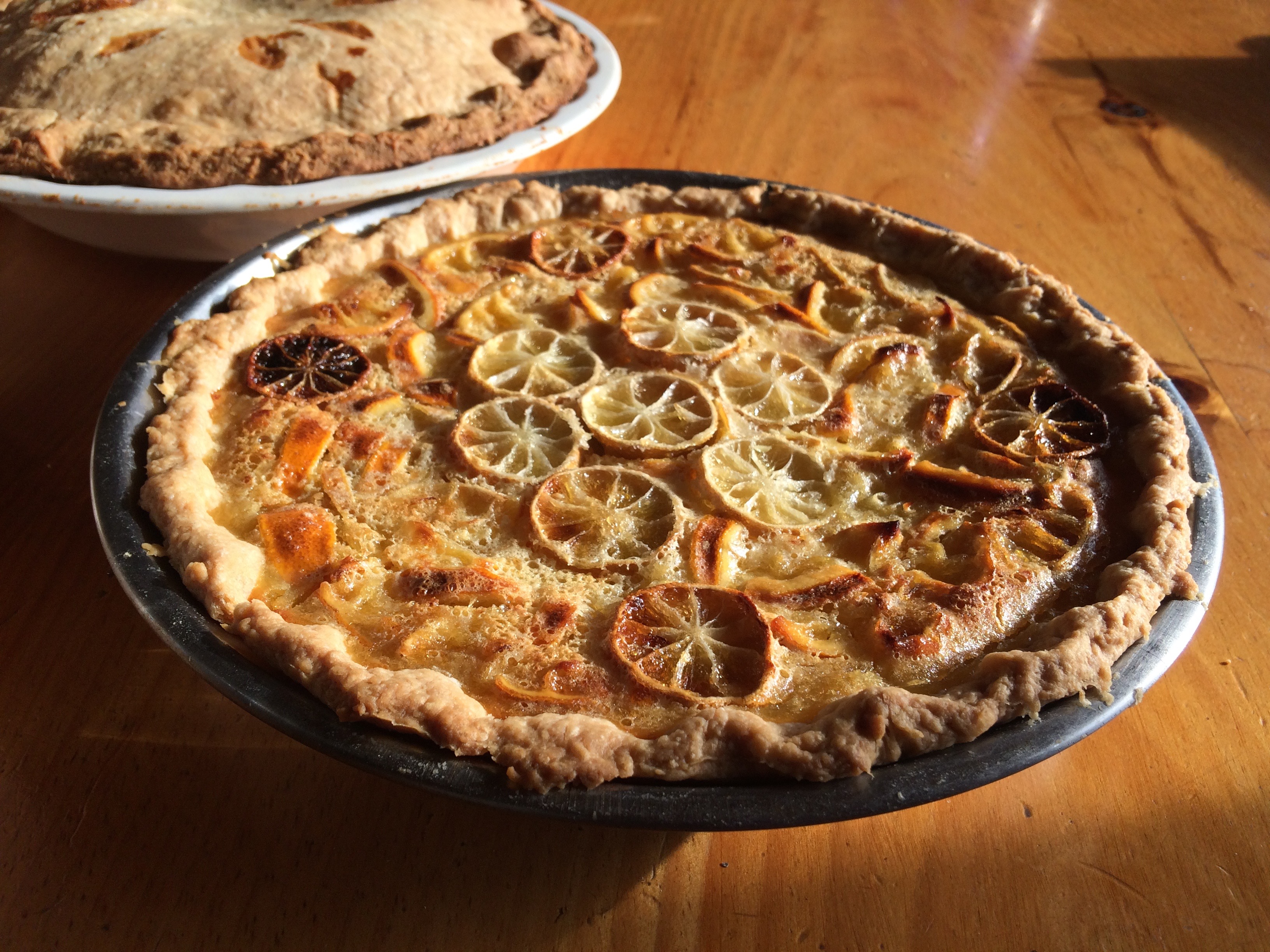
Shaker Lemon Pie story, plus.

by Ellen

Thanks to good drugs, I had no nausea or vomiting after my double chemo last Thursday. Go, Emend! I don’t care how expensive you are–I love you.  I do seem to be more worn out than usual.  Or than I expected.  Since my legs felt stronger, I went for a walk beyond the mailboxes on Thursday or Friday, and I made it back! With a few rests. But this weekend I have mostly sat around and indulged in Netflix, at least when not learning new blog posting technologies such as below.

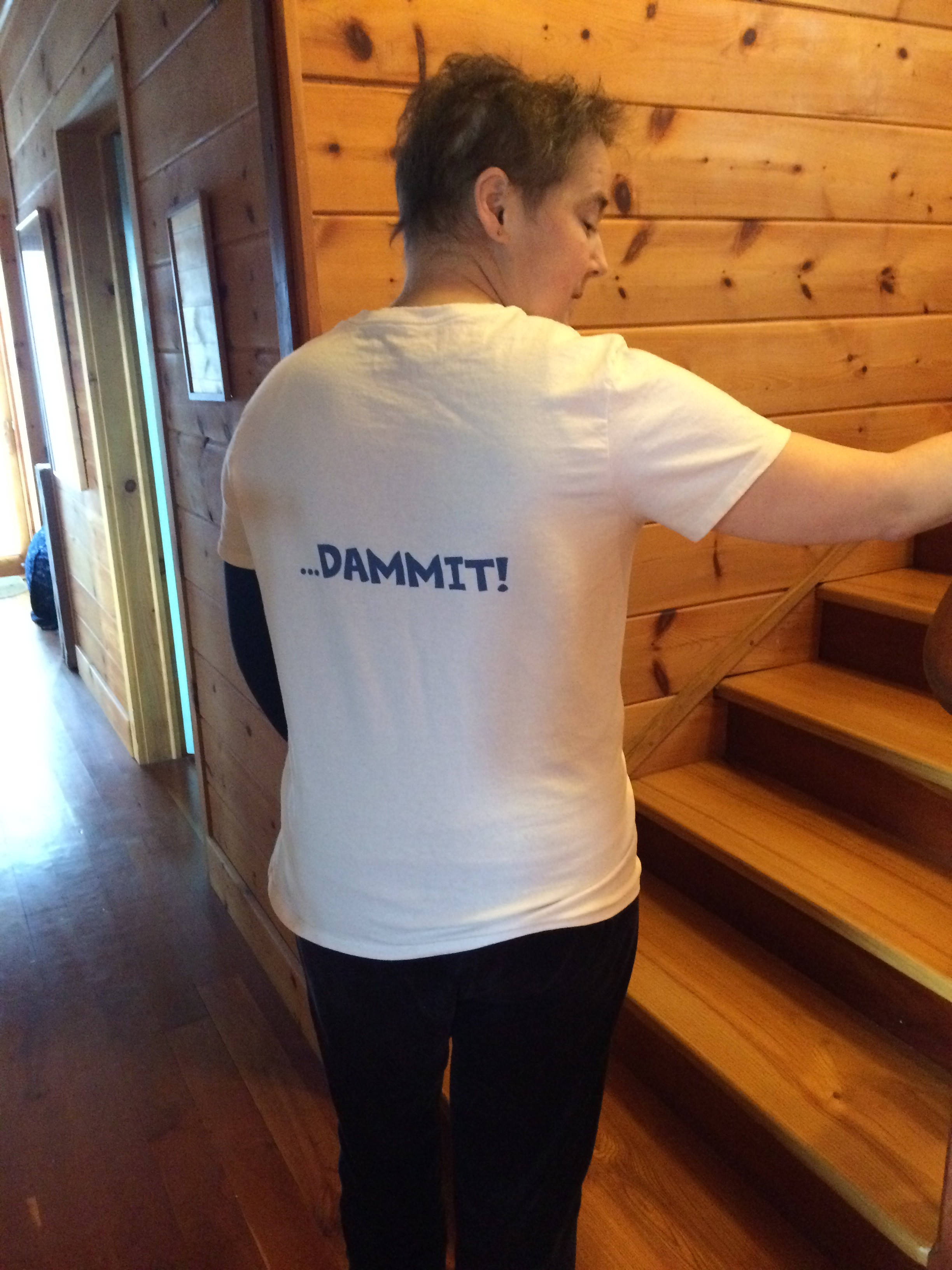
In general, though, I feel all right and I’m doing pretty well at taking care of myself except for the things that require two functioning hands. Unfortunately, this includes putting on most shirts and other important self-care tasks. My hands are damaged from chemo-induced neuropathy and we don’t know yet whether, now that I’m on a different chemo regimen or two, they will get worse or better. My feet are still pretty bad, especially the left one, which feels like a block of tingly wood that does not want to be touched.  That left foot is the major cause of my unsteadiness walking.

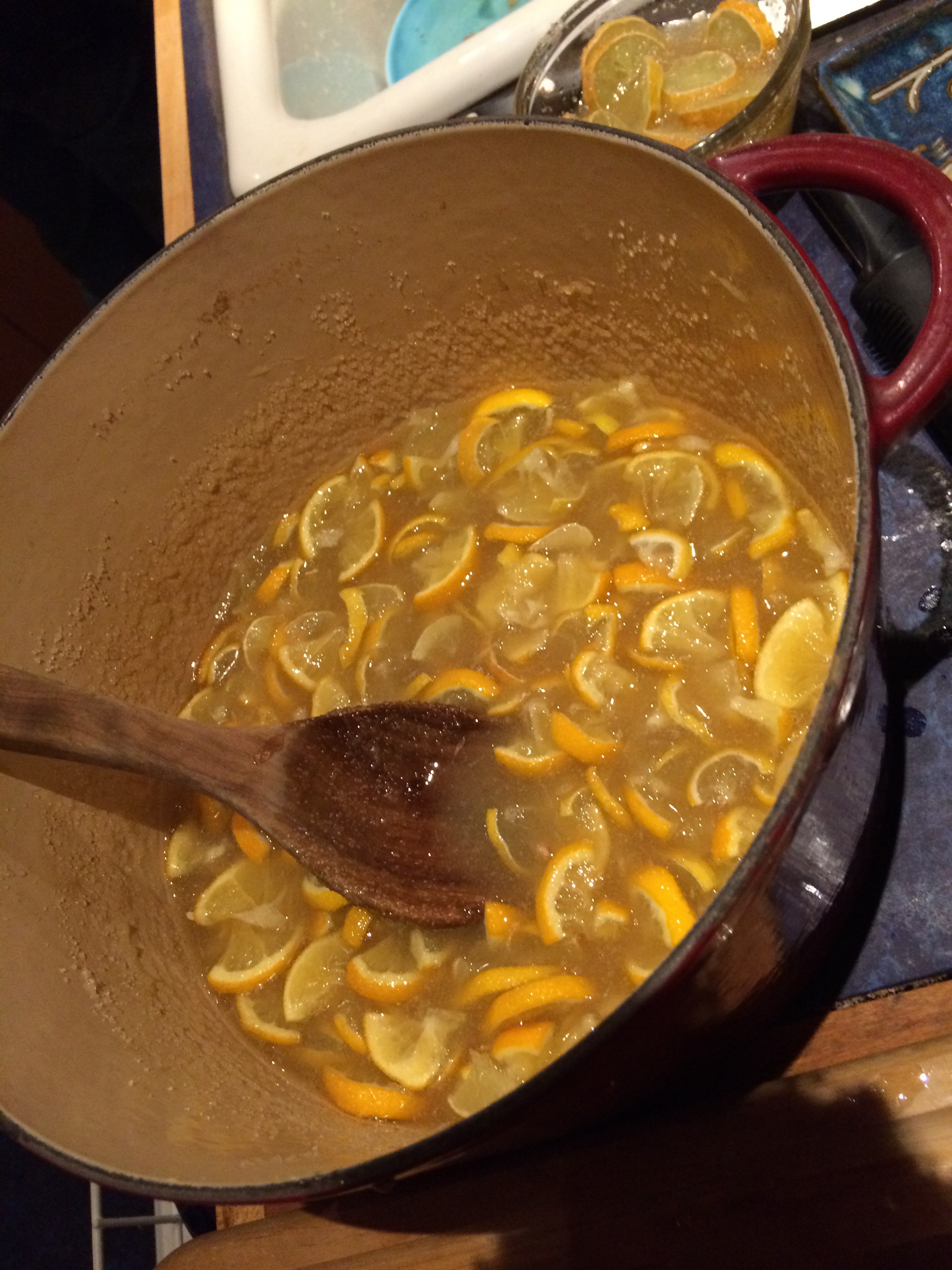
Here is last week’s community Shaker Lemon Pie story out loud:


Lemons and sugar Lemons and sugar

IMG_1425 One-crust pie


IMG_1426 Two-crust pie

Prevailing mood post-surgery on double-chemo day #1

by Ellen

Chemo took a long time today but went fine.  When we met with my oncologist beforehand, he noted that even with a brain bleed and a hospital stay–which always kinda takes it out of a person–I was definitely clinically improved compared to my last few visits (meaning he could see the difference in my mood, energy level, and strength).  That was sure true–I could feel myself getting stronger and more stable in the legs even every day I was in the hospital.  And being more able to take care of dressing and stuff, too, despite the lack of one functioning hand and having, still, one block-of-wood foot.

After all, it's not brain surg--oh, yeah it was!

by Ellen

Call went well with the surgery yesterday midday and Paul has gone well cents. Haahaa

(“All went well with the surgery yesterday midday, and all has gone well since.”)  Just thought you all might like to see what I have been trying to live with re dictation software so far!

We are home and some beef stroganoff awaits me for dinner downstairs…so that’s the news for now.

Resting up at home after a nap together Resting up at home after a nap together

Still in the hospital, but otherwise great

by Ellen

Perhaps you are wondering how this latest day stuck in the hospital went.  Here's the report!

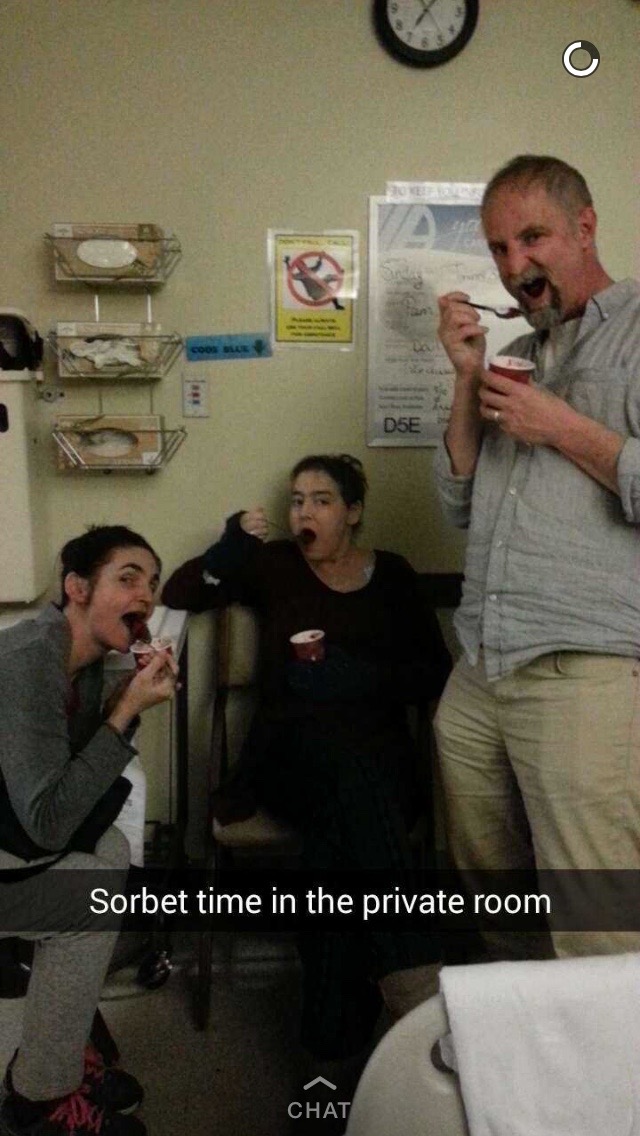
First night in the private room First night in the private room

Yesterday's final CT scan showed the bleed beginning to resolve.  Yay! So all was set for surgery today.  I was NPO--no food or drink--from midnight on, but got permission to skip the all-night IV fluid drip because of my previous horrible hospital-acquired edema  that pretty much disabled me for 3 weeks.  Then they kinda had to let me have ice chips this morning.

Surgery went well around midday and now—after 10 pm—Eric and I are in my observation alcove for the night (no more private room) and are enjoying ice cream after a delicious and long-awaited Panera soup, salad, and bread-and-butter dinner.  I think I ate enough to make up for all day’s no-food order!

We’re going for a walk around the floor soon, before Eric leaves for the night.  We walked 0.6 miles this morning before it was suddenly time to go to surgery.  I am feeling stronger in the legs every day, even in the hospital,

After he goes…*New Yorker* or Netflix w/ headphones until the dexamethasone I took late at 6 will let me fall asleep.  Patients in the neighboring alcoves seem to want the TVs on, even this late, so I will need the earplugs I received a few nights ago in an earlier loud alcove room down the hall.

We expect discharge tomorrow, whether early or late in the day.  Eric will be back in the morning to wait it out with me. Normally someone post-op with a brain bleed might be kept an extra day or two for Heparin and observation...but my neurosurgeon said he and my oncologist agreed they could only push me so far.

hidden toes hidden toes

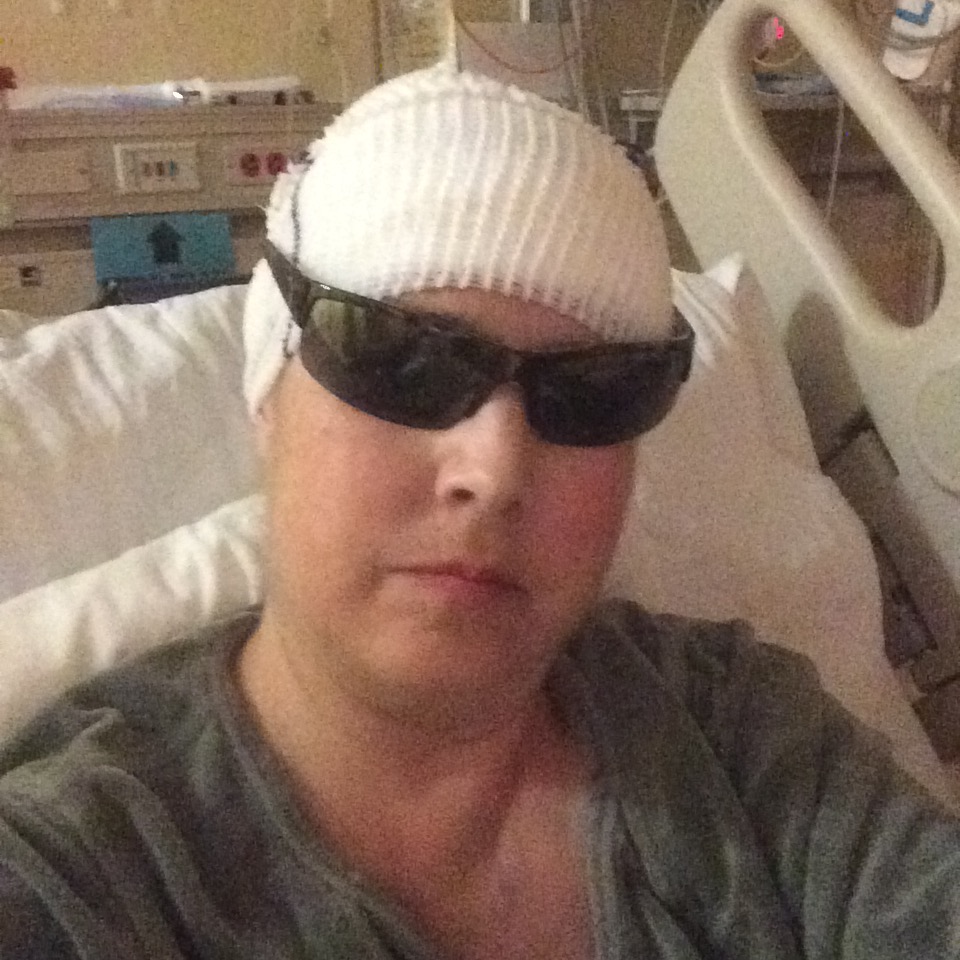
badass selfie! badass selfie!

Another evening update from the hospital

by Ellen

I am still in the hospital, but in a private room now so things are better.  Last night we--five of us--had a Thai food picnic along with cranberry-orange granita made by my friend Isa, and then Jesse and I watched our TV show together while snuggling and Eric did a bit of work in the family waiting room.

I did not get to go home, but surgery is scheduled for tomorrow. Morning, we hope.  Today I had vein studies (ultrasounds) to assess clot risk and another CT scan that the neurosurgeon will use like a GPS map tomorrow.  Other than that, it has been walking the halls, meeting new nurses, and doing a few bits of business with Eric, who arrived around 10 AM.

Right now we are waiting for Jens, Spee, and Jesse to arrive for dinner and hanging out. This is one of Jesse's two weekly nights at home, because they are boarding five days right now at Bard Academy. So I want to see as much of Jesse as possible even if I'm not home.

After an extra weekend spent at home instead of at Buxton--which ended up being spent largely here at the hospital or back-and-forth in the car--Will took one of our VW's back to school with him yesterday so he can come back and visit when he needs to.

Spirits are good even though I miss my bed and my sofa and my fire.  I have my people.

Quick evening update--good news

by Ellen

Just heard from my new nurse that my CT scan at 1 PM showed stable bleeding--so that is excellent news, no spread of bleeding to be seen today and no need to check my neurological all the time tonight. Woo hoo!

Still hoping to go home sometime tomorrow to await the Ommaya surgery when the neurosurgeon decides it's time.  Discharge will depend on both the Neurology and Neurosurgery services setting me free; then the Medicine service will cut me loose as well.

Even later and less greater happenings

by Ellen

Yesterday I got admitted to Albany Med for a little cerebellum bleed discovered when doing pre-admission CT scan for the Ommaya reservoir surgery Tuesday.  So now it's the next day and I am at AMC being checked every hour for neurological status, which is fine so far, despite a couple medium headaches.  Tylenol worked! I will be here most likely until tomorrow. Eric will be home this afternoon from his California work trip. My mom is here too until tomorrow.

Latest not-at-all greatest developments

by Ellen

The results of my recent MRIs were not good.  The pelvic MRI to see what might be causing left leg pain showed "patchy areas" in the cauda equina (nerves just below the end of the spinal cord). That worried everyone and triggered a quick repeat brain MRI and a cervical spine MRI to look for more deposits or "thickening" in various places.  Both showed evidence of more cancer-cell deposits on the lining of the spinal column and brain, which can cause swelling that impinges on nerves and do other damage to the nervous system and the brain.  Cancer in the cerebro-spinal fluid, which is called leptomeningeal carcinomatosis or leptomeningeal disease (LD), is just about the worst development in metastatic cancer.*  

Eric and I talked with my oncologist for half an hour Saturday morning (he gets called at home with bad results). We discussed treatment options and the option of no treatment--because the one standard treatment for LD only works half the time and has nasty side effects.  "Works" means you maintain the function you have--people don't (usually) get better from this.  Life expectancy with no treatment is only 4-6 weeks.  Life expectancy with standard treatment, according to one study, was a median of 7 months for LD from breast cancer, and shorter for LD from other common cancers. 

So that's sobering.  We had lots of questions and called him back that night to discuss them.  But basically I just don't think...or feel...that it's time to give up yet. 4-6 weeks?  I will try for those extra months as long as my quality of life is still decent despite side effects--headache, nausea, vomiting.  And more trips to Albany; twice-weekly chemo delivered--here's the cyborg part--directly into my brain via a "reservoir" under my scalp, connected to a tube that reaches into one of my large ventricles.  That way the drug can be infused directly into my cerebro-spinal fluid (CSF).  It's called an Ommaya reservoir but I just call it the brain port.

I'm also planning to try taking penfluridol, an old oral antipsychotic drug that seems to kill triple-negative breast-cancer cells...apparently in people (retrospective study) and definitely in mice (randomized controlled trial). Would that I were a mouse. But at this point I'll try it anyway if I can.  The exciting thing about this drug is that it acts in the brain perhaps even more strongly then in the rest of the body. Most chemotherapy drugs, by contrast, do not cross the blood-brain barrier at all.  So for someone with cancer in the body and worse cancer In the brain, it seems worth it to start acting psychotic right away.

There don't seem to be cutting-edge or novel ways to treat leptomeningeal disease that are being done at bigger cancer centers; the standard of care is methotrexate everywhere, It seems. Eric and I were exploring the idea of going somewhere bigger and busier to deal with this complication because a place like Dana-Farber would probably have more experience with LD than our one oncologist here in Albany. But that introduces the need to drive long distances for treatment, which decreases quality-of-life quite a bit. We also asked about and looked into clinical trials but have yet to find anything that fits.

We are still draining my left lung every three days and the amount of liquid is going down, Which may mean that the chemo I'm on now is working to kill off little cancer cells. Cross your fingers!

I am now back on high-dose steroids to decrease brain and spinal-cord swelling, Which could mess with my nerves or cause a seizure. No one will ever see my cheekbones again. I am very sad about this. And a lot of me does not quite believe how this is going–that is, about as badly as it could go. But on the other hand my foot edema is gone and my daily headaches went away and although I have LD, it does not seem to be kicking my butt with its patchy deposits at the moment.

More later on all the thoughts this makes us all think...

*LD is more common now that more women are surviving longer with metastatic disease--the cancer has more time to find its way into the CSF.

Palliative care

by Ellen

What comes out of my pleural space What comes out of my pleural space

This morning we had our first visit from a palliative care nurse.  We got set up with the Visiting Nurse Association for oversight of the lung-draining process, which continues every other day for now.  Then we found out that the VNA also has a palliative care program so we signed up for it. Now we have someone who can help us investigate various pain-relief options and also set me up with a visiting occupational or physical therapist who can help with my left hand. As part of this they offer something called anodyne therapy which I had never heard of, but which looks like it might help my hand pain. Anybody ever had any experience with this kind of treatment? It seems to work by increasing circulation.

She also gave me yet another end-of-life document to fill out: a MOLST or Medical Orders for Life-Sustaining Treatment. ****I thought all my work on the Five Wishes document was all I needed to do, but apparently not.  So I will tackle that eventually.

The foot and leg edema that was an unfortunate gift of my last hospital stay is getting better slowly. My right leg and foot are pretty much all better and that leg feels stronger lately too.  My left leg is no longer swollen but my left foot is still kind of a puffy mess.  Yesterday when we went to the office of the compression-garment expert, I not only got a compression glove for my left-hand–to address the edema in my fingers as well as protect that hand from accidental touching–but we also asked her advice on the foot edema. We have been getting different stories from different semi-experts about what might help besides elevation and eating lots of protein. She suggested a compression stocking and explained why there’s no such thing as a compression sock. She had some samples, so now I have a pair of nice black light-compression knee-high socks and I think wearing one is already helping the foot a little bit.

Eric goes to California on Sunday for a week and my mom comes Sunday night for the duration. I am lucky to have so many retired and self-employed people in my family who can come visit when it’s needed!

I didn't sign up for this.

by Ellen

I think I have made my peace, or as much peace as I can right now, with the fact that I most likely will die much sooner than everyone else I know.  Of course this sucks, but I don’t find in myself a lot of feeling that it’s unfair. I don’t ask, “Why is this happening to me?” *This–*the likelihood of dying soon–is kind of what I’m signed up for at this point.  So I’ll try to make something good come out of it too.

What I have not made peace with is the amount of pain I am experiencing along the way, or the disability that comes from my peripheral neuropathy: the numbness, tingling, shooting zapping feelings in my feet and the numbness, constant cold sensation, weakness, and clumsiness in my hands–plus pain with most contacts of the left hand, which I keep tucked away in a mitten for protection.  I am basically one-handed right now and that one hand ain’t so great.

The back pain that was my daily torture for months has subsided substantially, and my daily headaches have pretty much gone away. Those are good developments.  But the extreme edema left over from my December hospital stay has caused a lot of foot and leg pain and made it even harder for me to walk.  Before the hospital it was hard for me to walk any distance, but since then I have a lot more weakness and pain in my legs–maybe due to something called steroid myopathy.  (Still working on getting off steroids.)  It is painful and hard to stand up and I am unsteady as I shuffle around.  And my knee still mysteriously hurts.  And my neck muscles spasm some mornings for an hour or so.  Why? Who knows.  (I am taking various drugs to address the pain with varying results.)

So when it comes to the daily pain burden and the increasing disability, I do wonder, “Why does my journey have to include all this? It’s not fair.  It’s too much.”  It’s harder for me to handle than the underlying fact of incurable cancer.  If there is a way I can keep on living despite this disease, does that mean years ahead of hurting this much every day? Of needing this much help with daily basics like getting dressed?  Wow.  I sure did not sign up for that.

Phase Two: Definitely the "one damn thing after another" zone now

by Ellen

Friday 12/18 after chemo I was feeling pretty good overall–the Zofran was working to keep nausea away and I didn’t feel too bad. But then Saturday I woke up feeling totally knocked down. I couldn’t walk to the bathroom without help.  Not only were my major muscles weak, I felt sort of like sludge was in my blood vessels instead of blood. Sunday afternoon we talked to my oncologist and decided to go to he ER to find out what was going on–most likely the pleural effusion had built up again and would need a more aggressive solution than the one-time drainage of the previous Wednesday.

In the ER they use an ultrasound to confirm that the pleural effusion was back and was interfering with my breathing and oxygenation. But as an early Christmas present, they also followed some clues from the EKG they did to find out that I had fluid around my heart as well. That was not an emergency, but needed to be dealt with pretty soon before it became dangerous. So I was admitted to Albany Medical Center yet again to have two procedures done the next day: a drainage catheter put in to the space around my heart for a couple of days and a more permanent catheter installed to drain the space around the left lung.

Glimpse of oncologist using his wiles to get me moved to the oncology area, a better neighborhood of the hospital Glimpse of oncologist using his wiles to get me moved to the oncology area, a better neighborhood of the hospital

I spent Sunday night in the hospital, had the two procedures both done on Monday afternoon, and was discharged on Thursday, Christmas Eve. Since then I have been home sitting on the couch or in the bed waiting to feel better and having Eric drain fluid out of my lung every afternoon. How romantic!

We went to NYOH yesterday to see about chemo, which was on the schedule, but I didn’t really feel well enough yet. My feet and legs are really swollen from the IV fluids I got in the hospital and it’s painful to walk. I guess I am less out of breath now. So that’s the short story of the latest bumps in the road. There may be more to do with the heart, depending on whether the fluid is building up again. Both buildups are caused by tiny cancer cells blocking the drainage of normal fluid, so killing the cells off is really the only solid solution.

In other news, both kids are home from school and my mom is visiting so there are lots of people around to help this invalid get through the day.

In other bad news, the reason I need so much help is that the neuropathy in my hands got worse enough during my time in the hospital that I can’t touch-type anymore, and can’t do a lot of other things, like buttons and opening jars, requiring reasonably working hands. Besides them being clumsy and numb, one hand also hurts when touched by almost anything, or used, or lowered below the waist.

Had to add a few more equally obvious Don'ts. Had to add a few more equally obvious Don’ts.

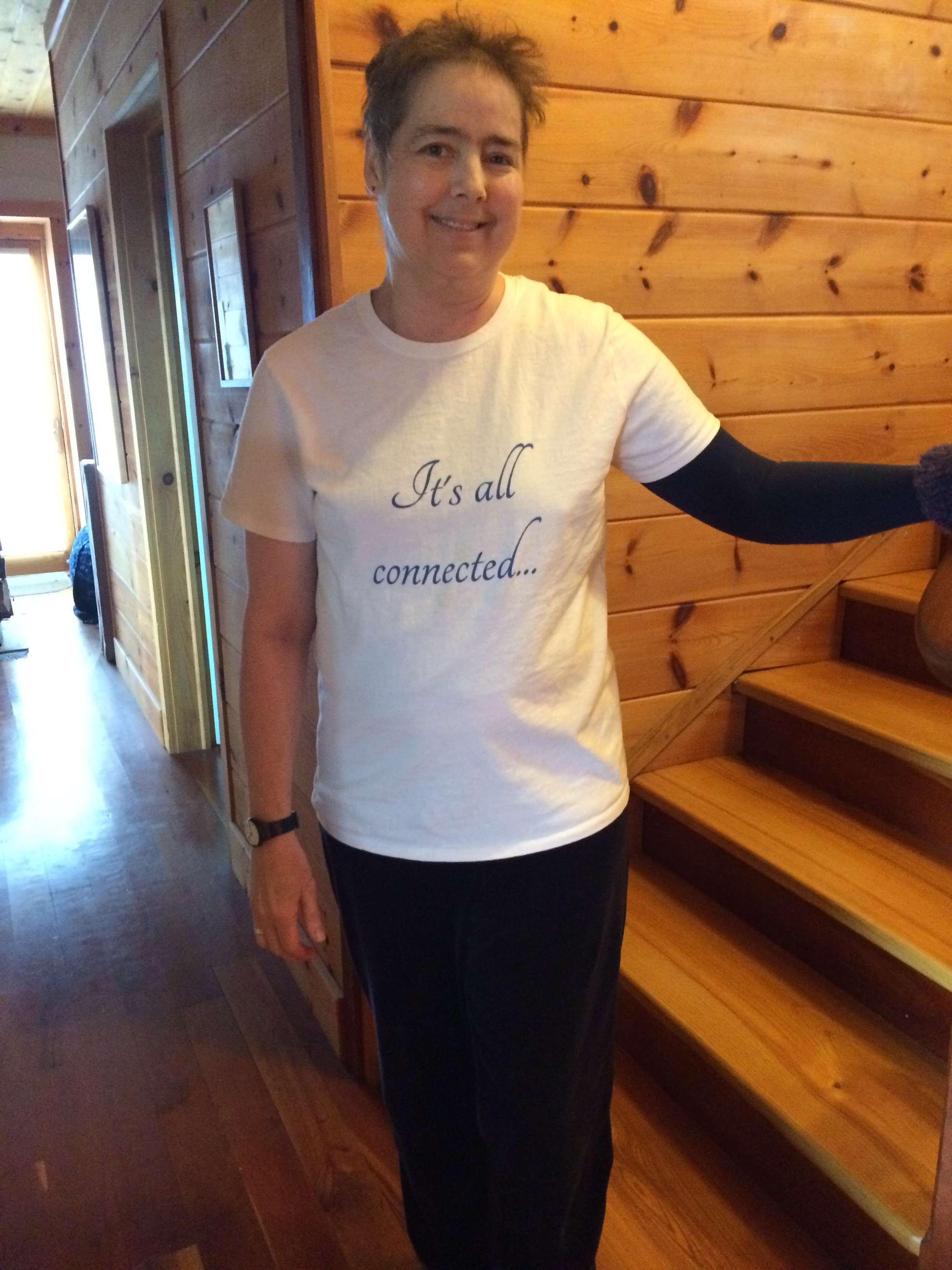
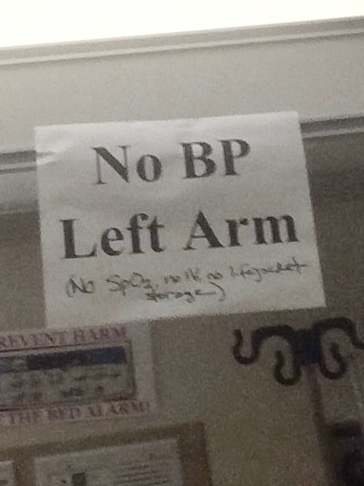
In the plus column I’ve gotten the lymphedema in my left arm under control so I can wear the lighter and more comfortable compression sleeve and gauntlet during the day and only wrap my arm in the graduated-compression bandages at night.  In the hospital, though, it was bandages 24/7 and the nursing staff put up a sign–which seemed so obvious given the big bulky bandages that we felt compelled to add to it:

**"No BP Left Arm"**

**"(No SpO2, no IV, no lifejacket storage)"**