Sharsheret
I am learning a bit about this organization Sharsheret and was really happy to watch this video interview of the founder…and note the date it was done: December 2010.

WORLD OF THE SICK / WORLD OF THE WELL
breast cancer...again?
I am learning a bit about this organization Sharsheret and was really happy to watch this video interview of the founder…and note the date it was done: December 2010.
ASCO (American Society for Clinical Oncology) top 5 evidence-based recommendations for 2013. Two are very relevant for me, one less so, two not relevant.
ASCO’s 2012 top 5 list. Two might sometime apply to me, two others are about earlier stages of breast cancer. An excerpt, from the one about when to stop chemotherapy:
Smith and Hillner15 suggested the simple rule that patients must be well enough to walk unaided into the clinic to receive chemotherapy. When oncology practitioners receive direct feedback about overuse and misuse of chemotherapy in the end-of-life setting, they quickly improve practice, with chemotherapy in the last 14 days of life falling from 50% to less than 20% in one quarter.35 Stopping anticancer treatment should always be accompanied by appropriate palliative and supportive care and referral to hospice, and the best practice would be continuation of palliative care started concurrently at the time of diagnosis for “any patient with metastatic cancer and/or high symptom burden.”Interesting that so much of these latest recommendations center around breast cancer rather than other cancers. (Lung & prostate are also mentioned often, but not much else.) Reasons might include: so many people have it; it's so often curable; treatment options are changing fast due to new drugs and lots of trials; high consumer pressure to improve treatment side-effects & efficacy (the effect of having mostly healthy patients, as in birth); more backward than other realms of cancer care?
I am having great fun watching these music-video parodies, which are knowledge translation about evidence-based medicine:
http://therapeuticseducation.org/videos
(Originally seen via Lamaze’s Science & Sensibility blog)
I “should” be working on my delayed paper for last semester’s Critical Inquiry class, which I am looking forward to digging into, but there is so much else to do right now that–imagine that–I haven’t done so yet. I still don’t know when my appointment is, with the Albany Med Neurosurgical dept. and the interventive radiologist, to discuss, plan, and schedule the brain treatment. Weird…the more serious it is, the less likely you are to have an appointment? If I needed a wart removed I would surely have an appointment.
So far I have only had the kind of cancer in which it’s the treatment that makes you feel so sick and unhealthy, not the cancer. I guess this makes me lucky.
However, it is kind of a weird situation to grapple with mentally. You are walking around harboring a deadly disease and you feel fine, you look fine, and you are not fine*. Then chemo makes you tired, sick or sickish, prone to catching whatever’s going around, and possibly bald. Plus a varied bouquet of other side effects depending on the chemo. And so you feel sick for sure. But it’s the medicine that’s doing it to you. Bizarre.
Last Friday, a week ago, I got home at 5 after the CT scan, bone scan, and signing up for the trial, went for a walk, and my phone rang at 5:39 with a call from "RESTRICTED." It was my oncologist calling from home to say that the CT scan showed spots in my brain. He hadn't seen the CT scan, just gotten told about it from the MD on call. He told me we had to go get an MRI ASAP via the emergency room to make sure there was not dangerous swelling and to see if I needed steroids or anti-seizure meds. Yikes.
So we went to the ER that evening. Got there at 7:15, eventually got neurologically checked out by the ER resident and the attending, and met the neurology resident. He said of the CT scan, "I saw the two spots, but I am not impressed" which made me laugh. Many nice people at the ER. Much slowness. I kept having to remind myself, when I felt panicky "what am I DOING here?" feelings, that I was only in the ER because that was the way to get an after-hours MRI. There was no emergency. I was not emergent at all, really.
I got the MRI starting at around 10:30 (Eric got to be in the MRI room, with earplugs and ear protectors and everything). The MRI folks were nice too. An hour of NOT MOVING MY HEAD got pretty difficult in the end due to a fold in the sheet covering the headrest, or something…slight discomfort because weird ledge-like feeling became a BAR OF FIRE because I wasn't allowed to move.
Then we waited another long long time for the neurology resident to read the MRI and talk to the attending neurologist, Dr. Kenning, who was at home. This was when I started to feel a bit like an animal in the zoo pacing around my cage.
So I seem to have two brain mets that are so far not causing any real symptoms anyone was impressed with. I said my eyes had been kinda blurry all day until evening, I said I had a headache but not a big one and wouldn't you if you'd spent all day at AMC getting injected and scanned and then come to the ER? None of that really worried anybody (although vision changes are an effect of brain edema). There were many tests to assess my neurological intact-ness, meanwhile Eric and I are programming a new feature to MANA Stats on his computer or I am reading the New Yorker or we are playing this really tricky videogame. Finally the resident reported that it looked the same on the MRI, 2 lesions, minimal swelling, and since I was showing no signs of any problems and was "neurologically intact" (*New Yorker* reading, check; programming, check; and the game was a real brain-twister) did I want to go home and come to see the neurologists on Tuesday? Well yes indeed I did. No steroids? No, no need for steroids. We left at 1:45 am.
So this is additional bad news for sure. However, it ended up not messing with our trip--although from Friday night to Sunday evening we figured we weren't going to New Orleans after all, due to having to see the neurosurgeon. However, he called Sunday and said that we should go, that he would start setting things up the week I am back, that we wouldn't lose any time in the treatment plan if I just came in a week later since it was Christmas week etc. Great! So unexpectedly, we went, and I am currently sitting in my mom's living room in her newly-acquired house in the Marigny neighborhood of New Orleans, having just walked all over the French Quarter with Eric. The only trade-off was having to take low-dose steroids just in case of swelling while I am gone. He said if he had actually *seen* me then maybe he would feel comfortable without me taking anything, but under the circumstances...
Next week we'll meet with the neurologist and the radiation oncologist and they will have figured out whether they can treat the mets with stereotactic radiosurgery (http://www.nlm.nih.gov/medlineplus/ency/article/007274.htm or http://www.abta.org/care-treatment/treatments/stereotactic-radiosurgery/) or with regular surgery. Whole-brain radiation, which scares the crap out of me, is not used unless those other two won't work. The mets are in the left motor cortex and the cerebellum and the neurologist said they look, so far, reachable by radiosurgery. So that's…good? Because of where they are, I am now on the lookout for right-side movement problems or weakness (none) and problems with balance & coordination & walking (none). Also worse headaches than I have occasionally been having, and worse vision problems.
When the mets are "stable" then I will be eligible for a trial again…until then, I'm not. So that's another piece of immediate badness. And at the big-picture level, it makes my prognosis worse. Hard to treat the brain.
Moral: *Never* answer a call from an unrecognized phone number if you have advanced cancer!
Dateline: Albany Medical Center Imaging Center
One of the hard parts of this is how little certainty there is, at all levels big and small. The most obvious uncertainty is about how many more years I get and how I will get to live them. Then there’s the more immediate: after a consultation with Judy Garber at Dana-Farber on Tuesday, and a long meeting with my oncologist at Albany Medical Center/NY Oncology Hematology on Wednesday, we still don’t know which treatment I’m going to be starting.
Here we are again. I really never thought I’d bring this blog back to life but it is going to be the way I keep everyone up to date on my latest adventures with breast cancer. And, if last time is any guide, it might be where I collect resources and information, share pictures, and post the odd thought on being in this odd position.
Having an invisible illness, especially one that doesn’t even have any symptoms at the moment, makes you an outsider in the regular world as well as an unfortunate insider in the world of the hospital or the world of oncologists. It is a deeply odd feeling to be looking through cancer-drug trials on clinicaltrials.gov to see if I qualify for a particular trial or not; when I do, I think, Yay!, and then immediately think, why are you happy that you fit the profile of someone who would need to enter a drug trial for metastatic breast cancer? (Well…consider the alternative.)
That’s what my surgeon said to me Tuesday afternoon as I got myself comfortable on the operating table at Albany Med’s somewhat sketchy-seeming “South Clinical Campus.” “Ready to be deported?” It took me a second. She was about the take out my port. I was ready.
It was truly weird to be fully conscious and lying there with a drape in between me and my right collarbone area while Dr. P. bustled around, injected some seriously burning lidocaine, and started pulling stuff out of me. First the catheter that went from the port into the subclavian vein, then through that vein to the superior vena cava near my heart. That was easy to remove. She sewed up the “track” the catheter made with a stitch or two and apparently that was enough to both close the hole in the vein and keep a hematoma from forming. (I know all this because I asked lots of questions. I asked lots of questions because it was far too weird to be lying there talking about something ELSE while this was going on. I tried that when the nurse asked me about being a doula, and it felt weirder and weirder to try to be two people at once: one being operated upon and one having a totally separate conversation. My hold on calm reality started to loosen.)
I’m done.
With the whole slash/poison/burn series of treatments for this summer’s breast cancer, at least. Today was my last zap. We keep getting asked “So now how do they know if it worked?” or “Test results coming back okay?” and we keep explaining that they–we–don’t know. That there are no test results. That all of this (beyond surgery) was Just In Case. That the jury’s out for oh, the next 5 or 10 years…ask us then and we’ll have an answer.
I have been following the story of an NPR reporter who has cancer (he has a blog). I found this posting of his pretty on-target.
That’s because when it comes to cancer, hair is the marker of sickness and wellness.
…I am still here.
Radiation every weekday 25 minutes away is a good excuse for not doing much else on the cancer-patient front. But I have done some else: a visit to the gynecologic oncologist to talk about ovaries, follow-up with the surgeon, a date to go back to the OR to get my port removed (1/23), and lots of reading. My lifetime risk of ovarian cancer is around 44%. This is of a cancer that is only caught at a curable state 25% of the time. Makes one think.
…and I am finding myself a little annoyed at how my head is turning this funny dark color.
I’m four treatments into radiation, which is daily, at 10:30 AM at Berkshire Medical Center. On the efficient days, I walk in, say hi to the techs, change, go into the zapper room and lie down, they position me, they put in the beam-benders and beam-blockers and leave the room and zap me. Then return, adjust the machinery, put in the second set of -benders and -blockers, and zap me again. Each zap is about 30 seconds. During which time the bright lights in the room go on, a red light on the ceiling that looks like a police-car light goes on, a buzzing noise fills the air, and silently and undetectably the machine beams radiation through my left breast. I lie there counting my breaths and trying to figure out how to visualize something positive about this instead of thinking of the Russian ex-spy who just died of radiation poisoning in London. Wish me luck.
Okay, okay, so I’ve been trying to pretend life is it’s old boring self and haven’t had any blog-worthy thoughts in a while. Here’s something I didn’t ever relate, though: during my second chemo treatment, Eric led me through a visualization of the chemo drugs as light filling my body and shining all through it. For the next two weeks, although I didn’t feel so hot, people kept telling me I looked “luminous” or “glowing.” What’s up with THAT?
Sounds great but today, day 3, I feel rotten. So I don’t feel done with anything yet. Although the chemo nurses blew soap bubbles at me when I was ready to go on Tuesday:
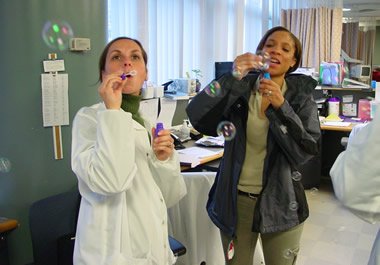
Tuesday evening I felt like I had been hit all over with a sandbag (pressure evenly distributed). Yesterday my mind was sharp but I was very tired (not sleepy, body tired) and spent the day in bed as much as possible. Today my mind is fuzzier and I am still tired. Queasiness held off a bit until today, which was nice. It’s not too bad, and my flu-head (chemo headache from the Cytoxan) is worse than last time but no worse than the first two times.
I realized on Sunday that what I’m doing with all these hats and bandannas is covering my head. It feels like covering. What I was doing in 1995 was hiding my head. No one else can probably tell the difference, the times I’m covering my head at least, but I can. What a relief.
There are two ways to go with the work/chemo juggling: you can go full-out, plan to live your Whole Life and make adjustments as needed as you go along–this will keep you feeling safe and normal as much as possible but will be hard work and things will go by the wayside unexpectedly (perhaps just the laundry, the dust in the corners, and the quality of lunchbox fare). Or you can decide that now is your time to lie low, take care of yourself, cut down on work and responsibilities, learn what you need to learn, explore other modes of healing that appeal to you, and do things you never give yourself time to do because of being a creative busy working mom (like read novels and hang out with friends? if you’re me).
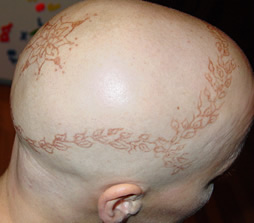
Sunday was a henna party. Here is my head (done by Arti and Meg):
Lately I keep facing this choice. Will today be a breast-cancer day or a regular day? Some days I don’t have appointments, feel all right, don’t do research or talk to other people in the cancer world, read novels, and get my “regular work” done. Other days I look things up online, let myself explore new Web sites that might hold useful information of one sort or another, read cancer-related books (see “bibliotherapy: sick”), talk to other people facing what I’m facing, make or go to appointments, and/or feel bad. And I am never quite sure which day I’m going to have, at least on a non-appointment day. Sometimes I get sucked in, sometimes I resist, other times I tell myself it’s useful and helpful to just go with the flow and follow my impulses as to what the spend my time on. I guess my goal is to prioritize the important breast-cancer stuff while not becoming a full-time obsessive breast-cancer junkie; and meanwhile, to get the “regular work” done on a reasonable schedule. All while not stressing out about either one.